

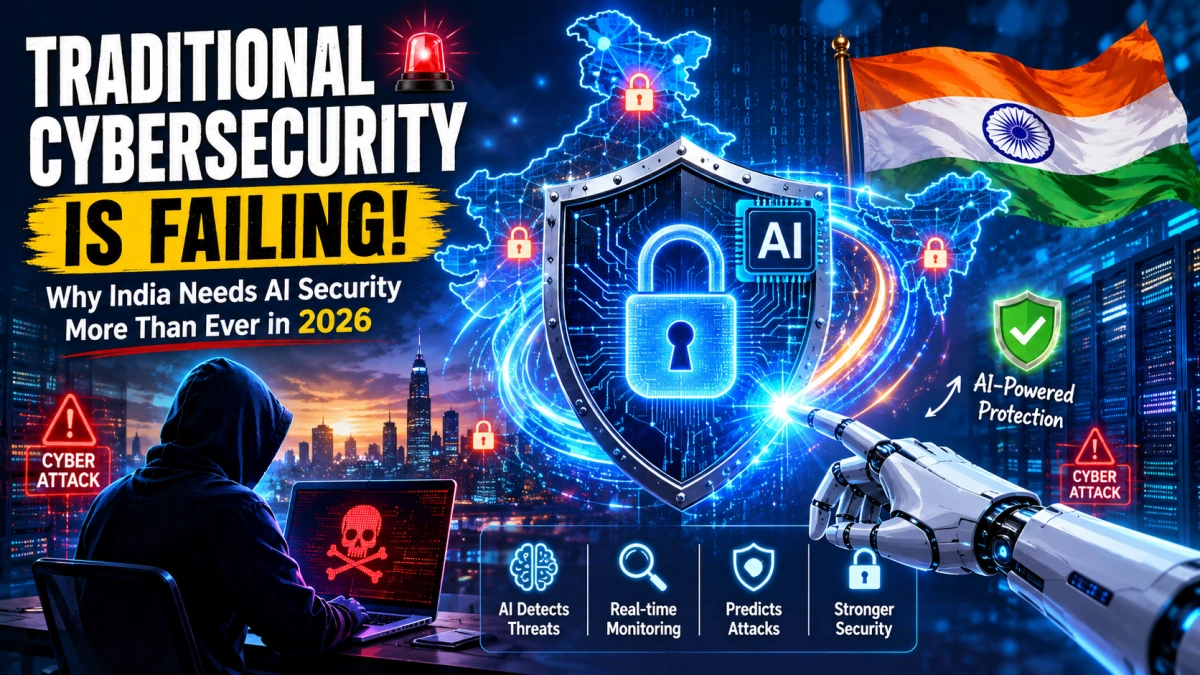
India Warns Traditional Cybersecurity Is Failing: Why AI Security Will Matter More in 2026
India's digital world is growing faster than ever — and so are the dangers hiding inside it. Experts across the country are now raising a serious warning: the cybersecurity tools that protected us for the past decade are no longer enough. Modern hackers are not just smarter — they are using Artificial Intelligence (AI) to attack faster, deeper, and more quietly than any human security team can match.
This is not just a tech problem. It is a national problem.
The Numbers Tell a Frightening Story
Before we talk about solutions, let's understand how serious the situation already is.
In 2025 alone, India's Computer Emergency Response Team (CERT-In) handled over 29.44 lakh (2.94 million) cyber incidents — issuing 1,530 alerts, 390 vulnerability notes, and 65 advisories. That is not a small number. That is roughly 8,000 incidents every single day.
Between 2021 and mid-2025, India recorded more than 2.2 million cybersecurity incidents, averaging more than 3,000 attacks per day, with financial services, healthcare, telecom, and government platforms among the hardest hit.
In 2025, spyware attacks against Indian businesses jumped by a staggering 72 percent — with Kaspersky's business solutions blocking 3,69,445 spyware attacks against Indian organisations, compared to 2,14,407 in 2024.
The financial damage is real too. The average cost of a data breach in India has reached $2.18 million — and in 2023, India ranked fifth globally for the highest number of breached accounts, with 5.3 million accounts compromised.
These are not future warnings. This is already happening.
Why Traditional Cybersecurity Is No Longer Enough
For many years, companies and governments depended on tried-and-tested security tools:
Antivirus software
Firewalls
Manual security monitoring
Password-based protection
These tools were built for a slower, simpler era of cyber threats. Back then, hackers needed time, skill, and patience to break into a system. Today, they simply let AI do the hard work for them.
Modern attackers are now using AI to:
Write convincing phishing emails in seconds — tailored to the specific person being targeted
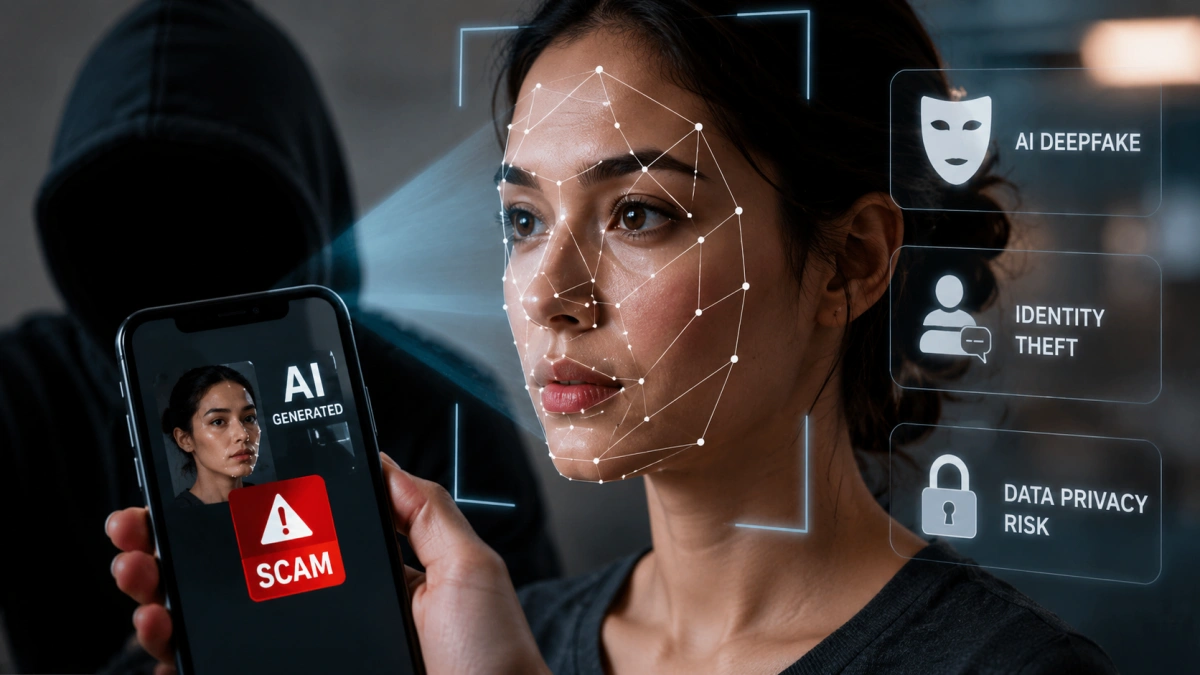
Clone real human voices to trick employees into transferring money or sharing passwords
Create deepfake videos of company executives giving fake instructions
Scan thousands of systems automatically for weak points
Launch attacks at machine speed, far faster than any human team can respond
Today, AI-generated phishing and business email compromise account for 22% of all cyber incidents in India — and many of these attacks now include voice-cloned and deepfake enhancements that make them nearly impossible to spot without advanced tools.
The old defences were never designed to stop this kind of attack.
AI vs AI: The Battle That Is Already Happening
Here is the uncomfortable truth: the same AI technology that powers helpful tools like chatbots and smart assistants is also being used by hackers. The only real answer is to fight AI with AI.
Companies and government agencies are now building AI-powered security systems that can:
Detect unusual behaviour on a network in real time — before a breach happens
Monitor millions of data points simultaneously, something no human team could ever do
Predict what kind of attack is coming based on patterns they have seen before
Block threats automatically, without waiting for a human to make a decision
Learn and improve with every new attack they encounter
India's own CERT-In is already moving in this direction — its Director General confirmed that CERT-In now leverages AI-driven analytics and automation to detect, prevent, and respond to cyber incidents in real time.
The future of cybersecurity is not just about having better tools. It is about having tools that think.
Why India Is at Greater Risk Than Most Countries
India is not just any digital economy. It is one of the fastest-growing ones on earth — and that growth comes with risk.
By 2025, internet connections in India crossed 100 crore (1 billion), compared to just 25.15 crore in March 2014. Average monthly data consumption per wireless subscriber increased nearly 399 times — from 61.66 MB in 2014 to 24.01 GB in 2025.
Hundreds of millions of people are now doing their banking, healthcare, education, shopping, and government work online. Every one of those interactions is a potential target.
India processed more than 21 billion UPI transactions worth ₹27 lakh crore in December 2025 alone. Imagine what a successful attack on that payment system could mean for ordinary people.
Critical infrastructure — power grids, hospitals, railway systems, water supplies — is also increasingly connected to digital networks. A successful cyber attack on any of these could affect millions of lives overnight.
The government clearly recognises this risk. The Union Budget 2025-26 allocated ₹782 crore specifically for cybersecurity — a clear signal that protecting India's digital future is now a national priority.
Real Incidents That Show the Danger Is Not Theoretical
This is not speculation. India has already seen what happens when cybersecurity fails.
Verified threat intelligence from 2025-2026 shows that trojans and file infectors account for 70% of all malware detections in India, while cloud misconfigurations were responsible for 62% of detections in cloud environments. Ransomware attacks — where hackers lock your data and demand payment to return it — have also surged, with ransomware-as-a-service groups making it easier than ever for even low-skill criminals to launch attacks.
Hospitals, banks, government portals, and telecom companies have all been targeted. In many cases, the attackers spent weeks inside systems before anyone noticed.
Cybersecurity Careers: One of the Safest Bets in 2026
Here is some genuinely good news inside this difficult picture: the growing threat is also creating one of the most stable and well-paying career paths in India right now.
India's cybersecurity ecosystem has grown into a $20 billion industry, powered by over 400 startups and 6.5 lakh (650,000) professionals — building advanced solutions in threat detection, cyber forensics, and AI-based monitoring.
And the demand is only going to grow. Companies are desperate for people who understand:
Ethical hacking — finding weaknesses before the bad guys do
AI security — building and maintaining intelligent defence systems
Cloud security — protecting data stored on remote servers
Network protection — keeping communications safe
Malware analysis — studying attacks to understand and stop them
Digital forensics — investigating breaches after they happen
The important thing to understand is this: even as AI replaces many technology jobs, cybersecurity professionals will remain essential. AI can help defend systems, but humans need to design those defences, interpret the results, and respond when things go wrong. A machine cannot replace the judgment and creativity needed to outsmart determined human attackers.
Why Students and Young Professionals Should Pay Attention
If you are a student, a recent graduate, or an IT professional looking for a direction — cybersecurity deserves serious consideration right now.
The field offers:
Strong job security — every industry needs cybersecurity professionals, from banking to healthcare to government
Competitive salaries — demand far outstrips supply, which drives pay upward
Continuous learning — the threats are always changing, which means the work stays interesting
Real social impact — protecting people's money, health data, and personal information genuinely matters
Starting points include certifications like CEH (Certified Ethical Hacker), CompTIA Security+, or CISSP. Several Indian universities and platforms like IITs and NASSCOM are also expanding their cybersecurity programmes specifically to address the talent shortage.
What Needs to Happen Next
India has made meaningful progress — CERT-In's scale of operations, the government's budget commitment, and the growth of the private cybersecurity industry are all encouraging signs. But the gap between the threat and the defence is still very real.
Closing that gap will require:
Widespread adoption of AI-powered security tools across both government and private sectors
Cybersecurity education starting at school level, not just in engineering colleges
Stronger data protection laws and faster incident reporting requirements
More investment in homegrown cybersecurity startups building India-specific solutions
Regular security audits for all critical infrastructure — mandatory, not optional
The hackers are not waiting. Neither should we.
Sources: CERT-In Annual Report 2025 (PIB), Kaspersky Threat Data 2025, Seqrite Threat Intelligence 2026, EIMT Cyber Attacks India Report, Eventus Security India Threat Report 2026.






















Comments (0)
No posts yet
Be the first to comment!