

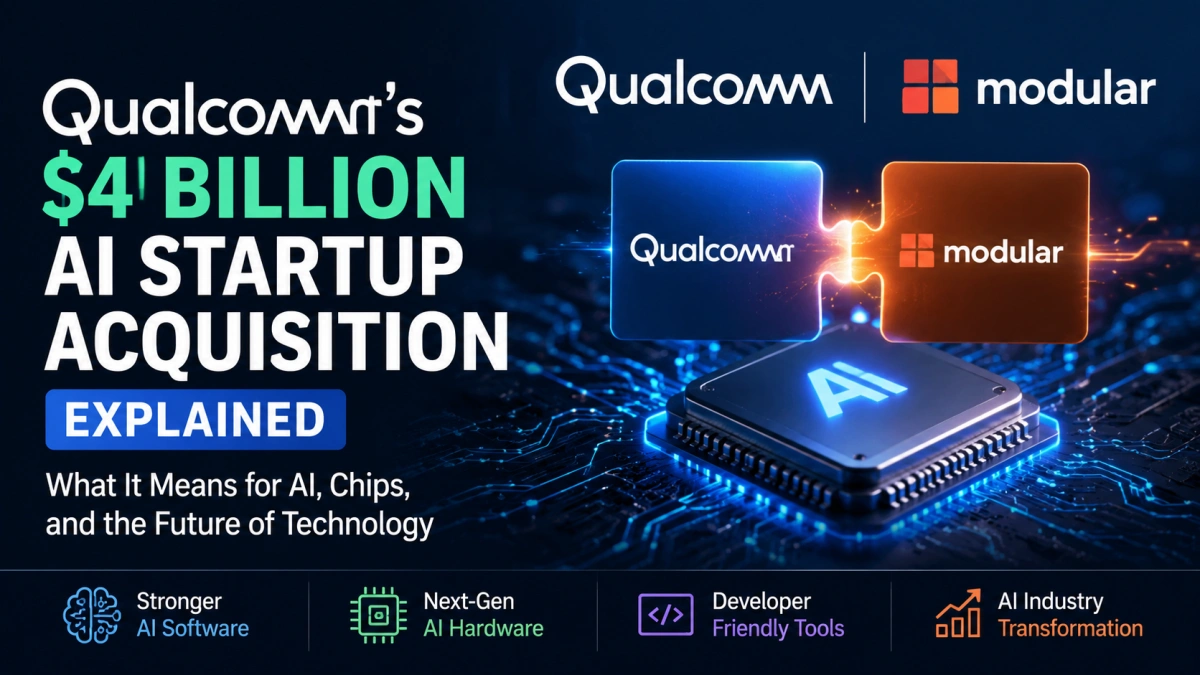
Qualcomm Acquires Modular for $4 Billion: A Bold Move to Challenge Nvidia in AI
Qualcomm has agreed to acquire AI software startup Modular in a deal valued at nearly $4 billion, signaling a clear and aggressive shift in the company's strategy — from smartphone chip maker to full-stack AI powerhouse.
This is not just another tech acquisition. It is Qualcomm's most direct challenge yet to Nvidia's dominance in the AI infrastructure market.
What Is Modular and Why Does It Matter?
Founded in 2022 by former Google engineers Chris Lattner and Tim Davis, Modular is an AI software company with a very specific and powerful mission: making AI models run efficiently across different types of hardware without forcing developers to rewrite their code for every platform.
Today, building AI applications is frustrating because every chip architecture — whether from Nvidia, AMD, or Qualcomm — requires different code. Modular solves this with a cross-platform AI deployment layer that dramatically reduces engineering complexity.
Its standout innovation is Mojo, a new programming language designed to combine the simplicity of Python with the raw speed of low-level languages like C++. For AI developers, Mojo is a game-changer — it allows high-performance AI code without sacrificing developer productivity.
Why Did Qualcomm Buy Modular?
Qualcomm has long dominated the Android smartphone processor market with its Snapdragon chip series. But the explosive growth of AI has moved the biggest opportunities away from smartphones and into data centers, cloud computing, and edge AI infrastructure.
By acquiring Modular, Qualcomm gains four critical assets: advanced AI software technology that works across hardware platforms, the Mojo programming language with a growing developer community, cross-platform AI deployment tools that reduce developer friction, and a world-class engineering team with deep expertise in compilers and AI runtimes.
In short, Qualcomm now has the software layer it needs to complement its hardware. Without great software, even the best chips struggle to attract developers — a lesson learned from watching Nvidia build CUDA over more than a decade.
A Direct Challenge to Nvidia's CUDA Ecosystem
Let's be honest about what this acquisition is really about: taking on Nvidia.
Nvidia's CUDA platform has become the de facto standard for AI development. Millions of developers worldwide write AI code specifically for CUDA, which locks them into Nvidia's GPU ecosystem. It is one of the strongest competitive moats in the history of technology.
Qualcomm wants to break that lock-in.
Modular's technology is hardware-agnostic by design. If Qualcomm successfully integrates and scales Modular's software platform, developers will no longer be forced to choose Nvidia hardware just because their code only runs on CUDA. They could deploy AI workloads across Qualcomm, AMD, Intel, and other processors with minimal changes.
This is a direct attack on Nvidia's most valuable asset — not its chips, but its software ecosystem.
What This Means for Businesses Investing in AI
For enterprises building AI-powered products — whether in customer service, healthcare, finance, logistics, or manufacturing — this acquisition could have real practical impact.
If Qualcomm's integrated platform delivers on its promise, businesses could see faster AI deployment with less engineering overhead, lower infrastructure costs by moving away from expensive Nvidia hardware where appropriate, greater hardware flexibility to choose the best chip for each workload, and improved performance across diverse processor types including edge devices.
Companies already evaluating AI infrastructure investments should pay close attention. A more competitive AI hardware market almost always benefits buyers through lower prices and more innovation.
What Developers Can Expect
For AI developers, the Qualcomm-Modular deal raises an exciting possibility: true hardware portability for AI applications.
Right now, optimizing an AI model for Nvidia GPUs often means it runs poorly on AMD or Qualcomm silicon — and vice versa. Modular's compiler technology is specifically designed to eliminate this problem.
If the integration succeeds, future AI applications built on Qualcomm's platform could run efficiently across multiple chip architectures without rewrites, take advantage of Mojo's performance improvements over standard Python, and benefit from a growing ecosystem of cross-platform AI tools.
Developers interested in following this space can explore Modular's developer documentation and the Mojo language community, which had already been growing rapidly before this acquisition.
Qualcomm's Broader AI Strategy
The Modular acquisition does not exist in isolation. Qualcomm has been systematically building toward a complete AI ecosystem for several years, with investments spanning AI-enabled Snapdragon processors for smartphones and PCs, automotive AI platforms for next-generation connected vehicles, edge AI devices for IoT and on-device inference, data center processors targeting cloud AI workloads, and high-performance computing initiatives for research and enterprise.
The company is no longer just a semiconductor business. It is positioning itself as an end-to-end AI platform company — from the chip to the software stack to the developer tools.
Challenges Qualcomm Must Overcome
Despite the strategic logic of this deal, success is far from guaranteed. Nvidia's lead is formidable and built over many years.
To truly challenge Nvidia, Qualcomm must win developer trust. Developers do not switch ecosystems easily, especially when their existing CUDA code works well. Qualcomm needs to offer compelling reasons — better performance, lower cost, or genuinely easier development — to attract them.
It also needs to build partnerships with the major cloud providers. AWS, Google Cloud, and Microsoft Azure are deeply tied to Nvidia infrastructure today. Without these platforms offering Qualcomm-based AI compute as a serious option, enterprise adoption will be slow.
Hardware improvement must continue as well. Software alone will not be enough. Qualcomm's AI chips need to compete on raw performance metrics like training speed, inference throughput, and memory bandwidth.
The Bottom Line
Qualcomm's $4 billion acquisition of Modular transforms the company from a chip business trying to enter AI into a genuine full-stack AI platform with software, language, and hardware capabilities under one roof.
Whether it can truly dent Nvidia's dominance remains an open question. Nvidia's CUDA ecosystem has a decade-long head start and extraordinary developer loyalty. But the AI market is still early, and history shows that entrenched platform monopolies can be disrupted when the right technology arrives at the right time.
For developers, businesses, and investors alike, this story is only beginning. The AI chip race just got a serious new contender.


















Comments (0)
No posts yet
Be the first to comment!