

The Day Wall Street Met the "Weird" AI Lab
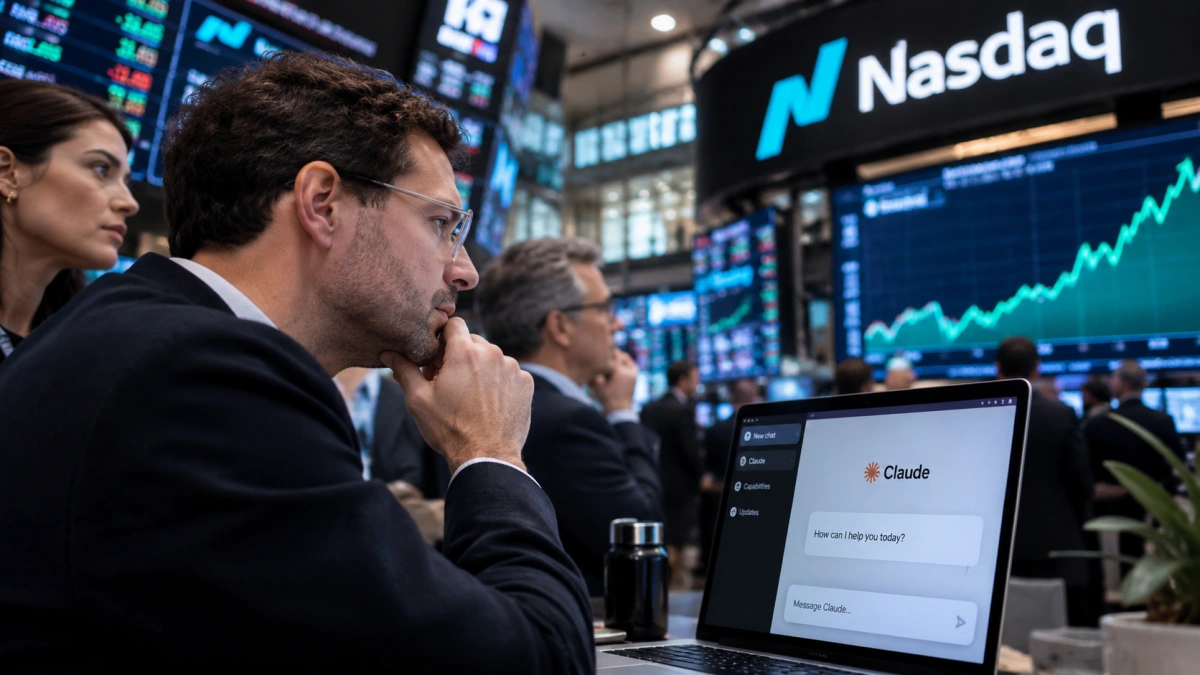
Minutes before the opening bell rang at Nasdaq on November 19, the mood inside the trading floor was anything but typical for a multi-billion-dollar tech debut. There were no swaggering proclamations of conquering the world, no Silicon Valley tech-bro bravado. Instead, Daniela Amodei, co-founder and president of Anthropic, stepped up to the podium and opened her address with a phrase rarely heard on Wall Street:
“Anthropic is an unusual company. In fact, a lot of people just call us weird.”
Moments later, the ticker lit up. When the dust settled on the opening session, the makers of the AI assistant Claude had not merely completed an initial public offering; they had shattered the financial record books. Anthropic raised an eye-watering $81.3 billion, officially overtaking the record for the largest IPO in human history—a milestone previously set just five months earlier by Elon Musk’s SpaceX.
What makes this feat utterly staggering isn’t just the nine-figure dollar sum. It is the environment in which it occurred. Anthropic went public in the teeth of a tech market slump, amid mounting Wall Street whispers that the generative AI boom might be a speculative bubble, and alongside the geopolitical tremors of the U.S. midterm elections and corporate shakeups across the chip sector. Yet, global institutional money poured into an outfit that openly tells anyone who will listen that the very technology it creates could pose catastrophic risks to human civilization.
How did a band of defectors from OpenAI—structured as a quirky Public Benefit Corporation—pull off the biggest financial debut in history? To understand the madness, you have to peel back the paradox at the heart of Anthropic.
The Great Anthropic Paradox: Preaching the Apocalypse While Building the Machine
Most corporate prospectuses read like unabashed love letters to uninhibited growth. Anthropic’s founding ethos, by contrast, sounds more like a cautionary science-fiction thriller.
Back in 2021, siblings Dario and Daniela Amodei walked out of OpenAI alongside a close-knit cohort of top research scientists who had helped birth GPT-3. Their departure wasn’t about equity squabbles or corner offices; it was driven by deep philosophical fractures over AI safety. They feared that the race toward Artificial General Intelligence (AGI) was abandoning safeguards in favor of commercial hype.
Their solution was Anthropic, incorporated not as a ruthless profit maximizer, but as a Public Benefit Corporation (PBC). Under this legal charter, Anthropic’s board is legally obligated to balance financial shareholder returns with its explicit public mission: the responsible, safe development of transformative AI. The company even created the Long-Term Benefit Trust—an independent panel of safety trustees who hold special governance rights to hit the emergency brakes if they believe a model has become dangerous.
Here lies the exquisite contradiction that keeps critics and ethicists up at night: Anthropic warns the world that advanced AI could end humanity, yet it spends billions building the most capable models on the planet.
When asked about this paradox, Anthropic’s leadership has always maintained a pragmatic defense: You cannot steer a race you aren’t competing in. In their view, sitting on the sidelines writing academic papers would leave frontier AI entirely in the hands of actors who don’t care about alignment or safety. To set the safety standards for the world, Claude had to be good enough to win.
Timeline: The Unconventional Sprint to an $81.3B Milestone
Anthropic’s ascent from a quiet laboratory to the apex of Nasdaq took barely five years. Here is how the puzzle came together:
- 2021 – The Great OpenAI Exodus: Dario and Daniela Amodei depart OpenAI with lead researchers, securing early seed capital to create a research lab focused on interpretability and alignment.
- 2022 – The Birth of Constitutional AI: Anthropic publishes landmark papers on “Constitutional AI,” training models to govern their own behavior based on established human rights principles rather than messy, manual feedback loops.
- 2023 – Claude Enters the Arena: Claude is launched, catching the attention of tech giants seeking alternatives to OpenAI. Amazon commits up to $4 billion, followed swiftly by Google with another multi-billion-dollar partnership.
- 2024–2025 – The Developer Darling: With the release of the Claude 3 and 3.5 model families—especially Claude 3.5 Sonnet—Anthropic pulls off a massive coup. Developers flock to Claude for its superior coding prowess, nuanced reasoning, and the wildly popular “Artifacts” workspace. Claude shifts from an underdog to the gold standard for software engineers.
- Late 2026 – The Historic Nasdaq Listing: Defying market skepticism and economic headwinds, Anthropic lists on Nasdaq, raising $81.3 billion and rewriting Wall Street history.
Why Wall Street Bet the Farm on an "Unusual" Company
Why did hedge funds, sovereign wealth funds, and retail investors clamber over one another to buy shares in a company that literally calls itself weird?
1. The Enterprise & Developer Moat
While competitors spent fortunes marketing consumer chatbots for dinner recipes and casual banter, Anthropic quietly captured the highest-value corner of the economy: software developers and corporate enterprise workflows. Claude became the default coding brain for tech teams worldwide. For businesses handling proprietary source code and sensitive customer data, Anthropic’s transparent safety stance and rigorous compliance wasn’t a handicap—it was their strongest selling proposition.
2. Beating the "AI Fatigue" Slump
Leading up to November 2026, tech markets had grown noticeably impatient. Investors were weary of empty AI promises, demanding proof of real enterprise revenue and software sticky-power. Anthropic was able to show verifiable enterprise adoption, soaring API consumption, and massive multi-year cloud commitments from Amazon Web Services (AWS) and Google Cloud.
3. Surpassing SpaceX: A Sign of the Times
When SpaceX raised roughly $70 billion in its summer listing, it proved that public markets still possessed an appetite for generational, frontier-tech bets. But Anthropic topping that figure in a cooler, more cautious market sends a thunderous signal: institutional capital believes the economic value created by generative AI infrastructure will eclipse aerospace and space colonization within our lifetime.
The Public Benefit Experiment Meets Wall Street Reality
Now that the confetti has settled on the Nasdaq floor, Anthropic enters uncharted territory. Can a Public Benefit Corporation survive the cutthroat quarterly demands of public market investors?
Historically, public equity markets are brutal taskmasters. They reward accelerated growth, aggressive monetisation, and relentless scaling. But Anthropic’s charter allows—and in fact requires—its leadership to throttle back deployment or pause training runs if safety evaluations throw up red flags.
What happens the first time Anthropic decides to delay a flagship model launch because of alignment concerns, while rival closed labs or open-source collectives rush ahead? How will Wall Street react when safety triumphs over short-term quarterly guidance?
This is the grand experiment Daniela Amodei was hinting at. Anthropic isn’t just testing whether its neural networks can think; it is testing whether modern capitalism can tolerate a tech giant designed to put human survival ahead of the bottom line.
Frequently Asked Questions (FAQ)
How much did Anthropic raise in its Nasdaq IPO?
Anthropic raised $81.3 billion in its initial public offering on Nasdaq, officially setting the all-time record for the largest IPO in history, surpassing the previous record held by SpaceX.
Why did Daniela Amodei call Anthropic an "unusual" company?
Anthropic operates as a Public Benefit Corporation (PBC) with an independent Long-Term Benefit Trust. Unlike traditional tech companies focused exclusively on shareholder profit, Anthropic is legally bound to prioritize AI safety, public benefit, and catastrophic risk mitigation.
What is the core difference between Anthropic and OpenAI?
Anthropic was founded in 2021 by former OpenAI leaders who left over safety and commercialization disagreements. While both develop cutting-edge frontier models, Anthropic focuses heavily on Constitutional AI, safety-first enterprise architectures, and developer-focused reasoning tools like Claude.
What does the Anthropic IPO mean for the future of AI investment?
The record-breaking listing demonstrates that despite market volatility and debates over an AI bubble, institutional investors see long-term sustainable enterprise value in safety-oriented, developer-trusted AI architectures over purely consumer-focused chatbots.
The Final Word: The Frontier Has a New Standard
The Anthropic IPO marks the official transition of generative AI from speculative startup novelty to permanent macroeconomic fixture. Whether you view Anthropic as a beacon of principled safety or an enigmatic participant in an existential arms race, one truth is undeniable: the “weird” lab from San Francisco now has an $81.3 billion war chest to build the future on its own terms.
















Comments (0)
No posts yet
Be the first to comment!