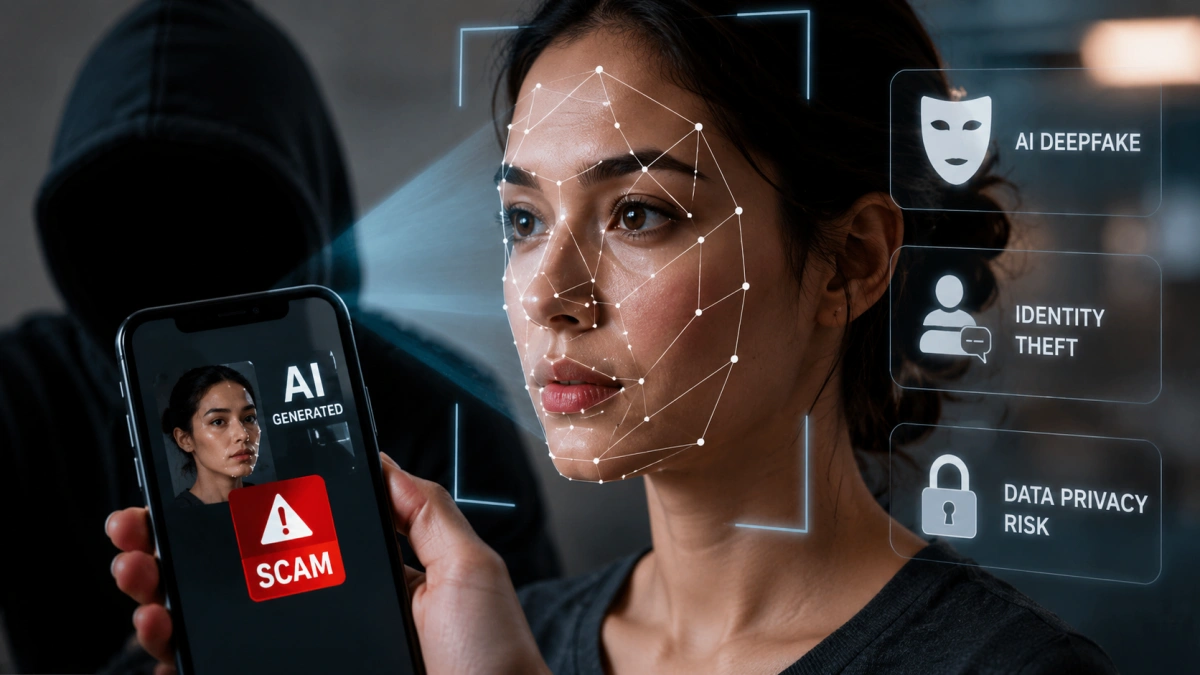
Your Face Can Be Used in AI Scams: 6 Things You Should Know
I was going through my Instagram feed one morning when I came across a video of a well-known Indian celebrity endorsing a cryptocurrency investment scheme. The video looked completely real — the lip sync was perfect, the voice matched, and the expressions were natural. Something felt off though, and after thirty seconds of watching I realised I was looking at a deepfake. That celebrity had never recorded that video. Someone had used AI to clone their face and voice entirely, and millions of people had already watched and shared it before it got taken down.
This is not a distant problem happening only to celebrities or people in foreign countries. It is happening right now in India, in WhatsApp groups, on YouTube, on Instagram, and through phone calls. Ordinary Indian people — homemakers, students, salaried professionals, small business owners — are losing money to AI-powered scams that use real human faces to build false trust. The technology has become so accessible and so convincing that even technically aware people are getting fooled. Understanding how these scams work is no longer optional — it is a basic safety requirement in 2024.
I spent time researching how AI face scams actually work, what the latest techniques are, how to spot them, and what you can do right now to protect yourself and your family. This article breaks it all down in plain language with no technical jargon. Here is everything you need to know.
1. AI Can Now Clone Your Face From Just One Photo
This is the part that shocks most people when they first hear it. You do not need to give anyone permission. You do not need to record a video. Scammers can take a single photograph of your face — from your Facebook profile, your LinkedIn page, your Instagram account, or even a group photo someone else posted — and use AI tools to create a fully animated, talking video of you saying anything they want.
The technology behind this is called deepfake generation, and the tools that power it are no longer limited to Hollywood studios or government intelligence agencies. Free and low-cost AI tools available online today can generate convincing face-swap videos in under ten minutes. Your face can be placed onto someone else's body, your expressions can be replicated, and a cloned version of your voice can be added on top — all from publicly available photos and audio clips.
For Indian users who share photos freely on social media — wedding photos, festival celebrations, office events, family gatherings — this creates a genuine vulnerability. Every public photo you post is potentially raw material for a scammer with the right tools and the wrong intentions. The face in your profile picture is enough to get started.
What this means for you: Audit your social media privacy settings immediately. Limit who can see your photos. Think twice before posting high-resolution face photos publicly, especially on platforms where your profile is visible to strangers.
2. Video Calls Are No Longer Proof That You Are Talking to a Real Person
Most people assume that if they can see someone's face moving on a live video call, they are definitely talking to a real human being in real time. That assumption is now dangerously outdated. Real-time deepfake technology has advanced to the point where scammers can run a live AI face filter during a video call that replaces their actual face with someone else's — a family member's face, a bank manager's face, a government official's face, or even your friend's face — in real time with almost no lag.
This technique has already been used in financial fraud cases in several countries, and reports of similar scams are emerging in India as well. The scam typically works like this — you receive a video call from what appears to be a known contact or a trusted authority figure. They tell you there is an emergency — a family member is in trouble, your account has been compromised, or you owe a government fine. The emotional pressure combined with the visual confirmation of a familiar face pushes people to act fast without verifying.
The signs to watch for during a suspicious video call include unnatural blinking, slightly off lip sync, strange lighting around the edges of the face, and a face that does not move naturally when the person turns their head sideways. These glitches are small but they are there if you know to look.
What this means for you: Never transfer money or share sensitive information based on a video call alone, no matter how real the person looks. Always hang up and call the person back on a number you already have saved to verify.
3. Your Voice Can Be Cloned in Under 30 Seconds of Audio
Deepfake technology is not limited to faces. AI voice cloning has become equally powerful and equally dangerous. Scammers need as little as 15 to 30 seconds of your voice — from a YouTube video, a public Instagram reel, a WhatsApp voice note that got forwarded, or even a recorded phone call — to create a synthetic voice model that sounds exactly like you.
Once they have your cloned voice, they can make it say anything. They can call your elderly parents pretending to be you, telling them you are in an accident and need money transferred immediately. They can call your employer pretending to be you requesting a salary advance. They can leave voice messages to your contacts that sound completely authentic. In India, where WhatsApp voice notes are used constantly for personal and business communication, voice cloning scams carry a particularly high risk of success.
There have already been documented cases in India where people received calls from what sounded exactly like a close family member's voice — crying, panicking, asking for urgent money transfers — only to discover later that the real family member had no idea any call was made.
What this means for you: Establish a secret code word or a simple personal question with your close family members that only you would know the answer to. If someone calls claiming to be a family member in distress, use that code immediately before taking any action.
4. Scammers Are Using AI Faces to Run Fake Investment and Job Scams
One of the most common and most damaging uses of AI face technology in India right now is in fake investment scams and fake job offer scams. Scammers create deepfake videos of trusted public figures — popular business personalities, news anchors, film celebrities, or even RBI officials — endorsing fraudulent investment platforms, stock trading apps, or cryptocurrency schemes.
These videos are then pushed aggressively through YouTube ads, Facebook posts, Instagram reels, and WhatsApp forwards. Because the face and voice of a trusted person are delivering the message, people believe it is a real endorsement. Victims deposit money into fake platforms, watch their balance appear to grow on a fake dashboard, and then find the platform has disappeared along with everything they invested — sometimes entire life savings.
The job scam version works similarly. A deepfake video of a company HR representative or a known recruiter appears in a WhatsApp message offering high-salary remote work. The victim is asked to pay a registration fee, a training fee, or a security deposit. Once the money is paid, the contact disappears.
What this means for you: No legitimate investment platform and no genuine employer will approach you through a WhatsApp forward or a social media ad featuring a celebrity. If you see such a video, search for the news about it — chances are a fact-check article already exists exposing it as a deepfake.
5. Your Children's Photos and Videos Are Also at Risk
This is the most uncomfortable point in this article but it is one that every Indian parent needs to read and take seriously. AI tools do not discriminate based on age — any face in any photo is usable. Scammers and bad actors can take photos or videos of children from parents' social media accounts and use them in deeply harmful ways — from creating fake missing child posts used to harvest donations, to far more serious misuse that I will not detail here but that every parent can imagine.
Beyond the extreme cases, there are also more common scams where photos of children are used to create fake emotional content — fabricated stories, fake fundraisers, manipulated images — that get circulated on WhatsApp and Facebook to extract money from well-meaning people.
Indian parents share an enormous volume of children's photos on social media — first day of school, birthday parties, sports days, family outings. While the intention is joyful and completely natural, the public visibility of these photos creates real risk in the current AI environment.
What this means for you: Set all accounts that contain your children's photos to private immediately. Avoid sharing high-resolution photos of your children in public posts. Be especially careful about photos that show school uniforms, school names, or location tags — these create identifying information that goes beyond just the face.
6. There Are Ways to Detect and Protect Yourself — But You Have to Know Them
The good news is that AI-generated content still has detectable flaws, and awareness combined with a few practical habits can protect you and your family very effectively. Here is what actually works right now.
Look for visual glitches in videos — deepfake videos often show inconsistent blinking, slightly blurred edges around the hairline, unnatural skin texture, and lighting that does not match the background. When watching any video that makes a financial or legal claim, pause and look carefully at these areas.
Use reverse image search — if someone sends you a photo claiming to be who they are, right-click and run a reverse image search on Google. If the face appears under a completely different name on another website, you have found a fake identity.
Verify through a second channel — if you receive a call, message, or video from someone claiming to be a known contact and asking for money or sensitive information, always verify by calling them back on their original saved number or through a different platform. A scammer cannot intercept your outgoing call to the real person.
Use AI detection tools — free tools like Deepware Scanner, Microsoft Video Authenticator, and Sensity AI can analyse videos and flag signs of deepfake manipulation. These are not foolproof but they add a useful layer of verification.
Report suspected deepfakes immediately — in India, you can report AI-based fraud to the Cyber Crime Portal at or call the National Cyber Crime Helpline at 1930. Reporting quickly helps authorities act before more people are affected.
What this means for you: Build the habit of pausing before reacting to any urgent request that arrives through digital channels — especially those involving money, personal details, or legal threats. Scammers rely on speed and panic. Slowing down breaks the trap.
FINAL THOUGHTS
AI face scams are not a future threat — they are a present reality that is already costing Indian families real money and real distress. The technology is advancing faster than most people's awareness of it, and scammers are exploiting exactly that gap. The six points covered in this article are not meant to make you paranoid about technology or social media — they are meant to make you sharper and safer while using the same platforms you already love.
Share this article with your parents, your siblings, and your friends. The most powerful protection against AI scams is not a software tool — it is awareness. A person who knows what to look for is far harder to fool than someone encountering these scams for the first time in a moment of panic.
Stay alert, verify before you act, and treat any urgent digital request involving money or personal data with healthy scepticism regardless of whose face you think you are seeing.
Disclaimer: This article is for informational and awareness purposes only. If you believe you have been targeted by an AI-based scam, report it immediately at cybercrime.gov.in or call 1930.