

Apple Returns After Four Years with Its Most Ambitious Living Room Upgrade
Four years in the consumer tech realm is an eternity. When Apple last updated its flagship streaming box back in late 2022, the digital living room looked quite different: streaming services were still multiplying, 4K HDR was cementing its mainstream presence, and voice assistants were largely confined to handheld remotes. Since then, smart televisions have become faster, rival streaming pucks have flooded the market, and generative artificial intelligence has fundamentally altered expectations of what ambient computing should look like.
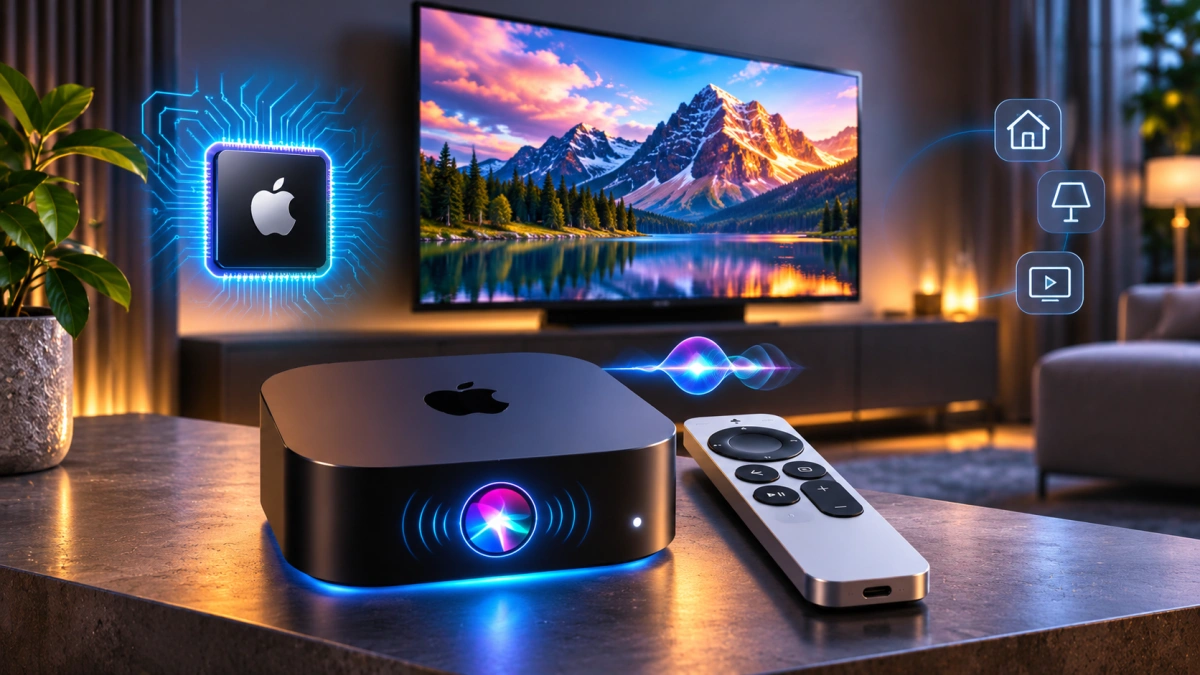
Enter the Apple TV 4K (2026). While its compact black puck silhouette appears deceptively familiar on your media console, virtually everything under its polycarbonate and aluminum shell has undergone a comprehensive generational overhaul. Armed with the blazingly fast A19 processor paired with 8GB of unified memory, a dedicated trio of far-field microphones for hands-free “Hey Siri” room voice control, hardware-level AV1 video decoding, and the unprecedented ability to tether up to four HomePods into a true spatial surround-sound home theater array, this is no mere spec bump. It is a calculated declaration that Apple wants to anchor the modern living room.
Over the past week, we have pushed the new Apple TV 4K through its paces—navigating high-bitrate 4K Dolby Vision workflows, benchmarking gaming performance on Apple Arcade, testing voice pickup during thunderous action movies, and hunting down the redesigned remote. Here is our complete, unfiltered review.
Design & Hardware: The Silent Powerhouse
Physically, the 2026 Apple TV 4K retains the fanless, compact thermal footprint that debuted in the previous generation. It is whisper-quiet, dissipating warmth passively through bottom vents without drawing dust into internal circuitry. However, closer inspection reveals several subtle, highly consequential external additions.
Tucked discretely around the exterior perimeter is an array of three studio-grade far-field microphones engineered with real-time acoustic echo cancellation. For the first time on an Apple TV box, you no longer need to grab the Siri Remote or fumble in the dark for a microphone button to control your television. You can simply speak into the open room: “Siri, play Severance Season 2 on Apple TV+,” and the hardware responds instantaneously.
On the connectivity front, the back panel offers a standard power inlet, an HDMI 2.1 port capable of 4K 120Hz signal throughput, and Gigabit Ethernet on the higher storage tier alongside Wi-Fi 6E / Wi-Fi 7 compatibility. It also acts as a primary Thread Border Router and Matter controller, making it the most capable smart home automation hub Apple has ever built.
The A19 Chip & 8GB RAM: Speed That You Genuinely Feel
Putting Apple’s flagship A19 chip—the very same architecture powering Apple’s latest pro-tier smartphones—inside a dedicated media streamer might initially sound like absurd overkill. After all, does anyone really need console-grade silicon just to binge Netflix or stream Disney+?
In practice, the benefits of the A19 silicon and its accompanying 8GB of RAM make themselves felt immediately across everyday navigation:
- Instantaneous App Switching: Where older streaming devices frequently reload background apps or freeze when switching between YouTube, Prime Video, and Plex, the 2026 Apple TV 4K keeps half a dozen heavy streaming apps completely suspended in memory. Switching is instantaneous, with zero splash-screen lag.
- 50% Faster CPU & 2x GPU Rendering: System animations in tvOS glide with butter-smooth 60 FPS and 120 FPS precision. Posters load without momentary gray placeholder boxes, and scrubbing through multi-hour 4K HDR video timelines is responsive and hitch-free.
- Hardware AV1 Video Decoding: The inclusion of dedicated AV1 silicon decoding is a major technical win. High-efficiency AV1 streaming reduces bandwidth consumption significantly while delivering visibly sharper bitrate fidelity and eliminating compression banding in dark, shadowed scenes.
- Console-Class Apple Arcade Gaming: With hardware-accelerated ray tracing and raw GPU headroom, graphical showcases on Apple Arcade run with desktop-grade visual effects, making this box a genuine alternative to casual micro-consoles for families.
Hands-Free Siri: When Ambient Voice Control Actually Works
Smart TV voice control has historically been an exercise in frustration. Most television microphones either mishear basic requests or require you to shout over whatever movie is playing at volume. Apple has clearly invested tremendous engineering resources into cracking this problem.
Thanks to on-device neural noise reduction, the far-field microphone array on the Apple TV 4K filters out dialogue and music emanating directly from your TV speakers. Even during high-octane explosions or thumping soundtracks, speaking in a normal conversational tone triggers the familiar Siri glow along the bottom corner of the screen.
Furthermore, because the A19 chip processes natural language requests on-device via a dedicated Secure Exclave, everyday queries like “Pause,” “Rewind 30 seconds,” “Turn on English subtitles,” or “What did he just say?” (which automatically rewinds 10 seconds and turns on temporary closed captions) execute without noticeable network latency. For privacy-conscious households, you can physically disable the microphones in tvOS Settings with a single toggle.
Quad-HomePod Surround Sound: A Genuine Home Theater Transformation
Perhaps the most exciting audiophile feature packed into the new Apple TV 4K is expanded HomePod pairing. In previous models, users were limited to pairing a stereo pair (two HomePods) for TV audio. The 2026 update shatters this limitation by allowing users to wirelessly link up to four HomePods simultaneously (such as two full-size HomePods in the front and two HomePod minis in the rear).
Setting up this 4-speaker array requires virtually zero manual calibration. tvOS automatically detects the speakers, calculates spatial room reflections, and configures a dynamic 4.0 Dolby Atmos spatial surround stage. In our listening tests with *Dune: Part Two* and *Top Gun: Maverick*, the immersion was breathtaking: audio pans from front-left to rear-right felt continuous and physical, dialogue remained crystal clear from the center phantom channel, and bass response had genuine theatrical authority without the mess of trailing speaker wires across the floor.
The Redesigned Siri Remote: Precision Finding Solves Couch Disasters
Few domestic frustrations are more universal than the TV remote sliding into the dark abyss between couch cushions. With the refreshed Siri Remote bundled with the 2026 Apple TV 4K, Apple has finally cured this headache.
The new remote integrates full Find My support with Precision Finding, powered by an internal Ultra Wideband (UWB) chip and a miniature high-output piezo speaker. If the remote goes missing, you simply open the Find My app on your iPhone, follow on-screen directional arrows down to the exact inch, and ping the remote to emit a series of loud, distinct chirps until it is retrieved. It retains the sleek sandblasted aluminum chassis, the intuitive touch-enabled clickpad, and the modern USB-C charging port.
Detailed Hardware Specifications
- Processor: Apple A19 (4nm architecture) with 6-core CPU and 5-core GPU
- Memory: 8GB Unified Memory
- Storage Capacities: 128GB (Wi-Fi) / 256GB (Wi-Fi + Gigabit Ethernet + Thread)
- Video Capabilities: 4K at up to 120 FPS, Dolby Vision, HDR10+, HLG, Hardware AV1, HEVC, H.264
- Audio Protocols: Dolby Atmos, Dolby Digital 7.1, Spatial Audio, Quad-HomePod Wireless Link
- Microphones: 3x Far-Field Array with Real-Time Acoustic Echo Cancellation
- Connectivity: HDMI 2.1, Wi-Fi 6E/7 with 2x2 MIMO, Bluetooth 5.4, Thread Mesh Networking
- Siri Remote: Aluminum unibody, USB-C rechargeable, Find My with Precision Finding and Speaker
- Operating System: tvOS 20 with Apple Intelligence ambient integration
How It Compares: Apple TV 4K vs. Competing Streaming Hardware
To understand the value proposition of the 2026 Apple TV 4K, it is helpful to look at how it measures up against rival high-end devices like the Google TV Streamer and Amazon Fire TV Cube:
- Interface Cleanliness: While Google TV and Fire TV have turned their home screens into cluttered billboards dominated by sponsored ads and auto-playing trailers, Apple TV’s tvOS remains completely ad-free, focusing exclusively on your personalized up-next queue and purchased libraries.
- Raw Processing Power: The A19 chip completely outclasses the low-power MediaTek and Amlogic silicon found in competing streaming sticks, ensuring the Apple TV will remain snappy and supported for the next 6 to 8 years.
- Ecosystem Synergy: From seamless AirPods spatial audio switching and Apple Watch fitness metrics overlaid on your television during workout routines, to viewing HomeKit security cameras in picture-in-picture, the integration is unmatched for iPhone and Mac users.
Frequently Asked Questions (FAQ)
What is the biggest difference in the new Apple TV 4K (2026)?
The primary upgrades are the inclusion of the flagship A19 processor with 8GB RAM, three built-in far-field microphones enabling hands-free “Hey Siri” room control without the remote, support for pairing up to four HomePods in a Dolby Atmos surround sound setup, and a redesigned Siri Remote featuring Find My Precision Finding.
Can the Apple TV 4K really hear you while a movie is playing loudly?
Yes. The box utilizes three studio-grade microphones with real-time acoustic echo cancellation that mathematically subtracts the audio output of the television speakers, allowing Siri to accurately detect your voice even during loud action sequences.
How does the quad-HomePod surround sound setup work?
With tvOS, you can wirelessly connect up to four HomePods (HomePod 2nd Gen or HomePod mini 2) directly to the Apple TV 4K. The system automatically balances the audio channels to create an immersive, wire-free 4.0 Dolby Atmos spatial audio soundstage.
Does the new Siri Remote have a built-in speaker for Find My?
Yes. The 2026 Siri Remote includes an internal speaker and Ultra Wideband (UWB) chip. You can use Precision Finding on your iPhone to track its exact location and play an audible chime to locate it between cushions.
Should I upgrade if I already have the 2022 Apple TV 4K?
If your 2022 model still performs smoothly and you don’t care about hands-free Siri or multi-HomePod surround setups, your existing unit remains very capable. However, for those with HomePods, smart home setups, or anyone who wants ambient voice control and Find My remote tracking, the 2026 edition is a deeply satisfying upgrade.
Final Verdict: The Gold Standard of Streaming Just Got Better
The Apple TV 4K (2026) is not merely the fastest streaming box on the market; it is a masterclass in living room refinement. By addressing the small, daily friction points of television viewing—hunting for misplaced remotes, shouting over loud movie volume, sluggish interface menus, and messy speaker cables—Apple has created an ambient entertainment hub that justifies its premium price tag.
For existing Apple ecosystem households and cinephiles seeking uncompromising 4K HDR playback and acoustic immersion, the new Apple TV 4K stands unchallenged at the very top of the streaming mountain.


















Comments (0)
No posts yet
Be the first to comment!