

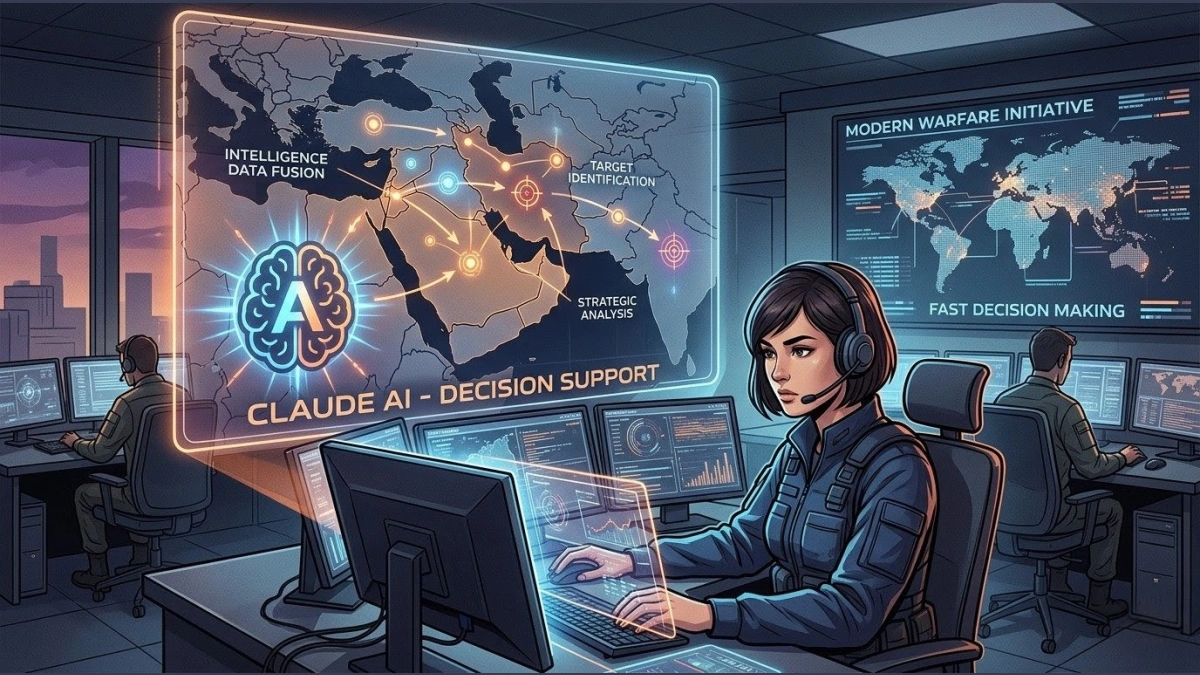
Artificial Intelligence is rapidly transforming many industries, and modern warfare is one of the biggest areas where AI is making an impact.
In 2026, reports revealed that Claude AI developed by Anthropic, played a significant role in helping the United States and Israel analyze military intelligence during operations targeting Iranian infrastructure.
According to reports, the AI system helped analysts i.
This highlights an important shift in modern conflict: wars are no longer fought only with missiles and soldiers, but also with powerful AI systems capable of processing massive amounts of data in seconds.
What Is Claude AI?
Claude AI is a large language model developed by the AI company Anthropic. It was originally created for everyday tasks such as:
Writing assistance
Research and analysis
Data interpretation
Problem solving
However, the same capabilities that make Claude useful for productivity also make it powerful for analyzing large datasets and identifying patterns.
Because of this, Claude AI was integrated into the Pentagon’s Maven Smart System
This system gathers information from multiple sources, including:
Satellite imagery
Drone surveillance footage
Signals intelligence
Battlefield reports
Claude AI helps combine all this information into clear insights that analysts can quickly understand.
From Intelligence Overload to Fast Decisions
Modern warfare generates huge volumes of data every minute.
Military analysts must process information coming from satellites, drones, radar systems, communication intercepts, and ground reports.
For humans alone, analyzing this massive flow of intelligence in real time is almost impossible.
This is where Claude AI becomes extremely valuable.
The AI system can quickly:
Scan large volumes of intelligence data
Detect unusual patterns or suspicious activity
Rank possible targets based on threat level
Simulate potential battle scenarios
This significantly speeds up what military experts call the “kill chain.”
The kill chain refers to the process of:
Detecting a target
Analyzing the threat
Deciding on an action
Executing the strike
Traditionally, this process could take days or even weeks.
With AI support, it can now happen within hours or even minutes.
AI as a Decision Support Tool
Despite its powerful capabilities, Claude AI does not make the final decisions in military operations.
Human commanders still evaluate the data and approve actions.
However, Claude AI acts as a real-time decision support system by providing critical insights quickly.
It helps military teams by:
Highlighting high-priority targets
Predicting potential enemy movements
Simulating the outcomes of military actions
Combining multiple intelligence sources into one clear analysis
By doing this, the AI allows commanders to make faster and more informed decisions during high-pressure situations.
Other AI Technologies Used in Warfare
Claude AI is just one example of how artificial intelligence is shaping modern military operations.
Several other AI technologies are also being used in defense systems around the world.
Data Fusion Systems
These systems combine data from satellites, drones, and electronic signals to create a complete picture of the battlefield.
Instead of reviewing separate reports, analysts can see everything in one unified system.
Predictive Modeling
AI models can analyze historical patterns and intelligence signals to predict enemy movements or possible escalations.
This helps military planners prepare strategies in advance.
Military Simulations
Advanced AI simulations allow military planners to test strategies in virtual battle environments before deploying real troops or equipment.
This reduces risks and helps refine operational plans.
Together, these technologies are reshaping how wars are planned and executed.
Ethical and Political Concerns
While AI brings powerful advantages to military operations, it also raises serious ethical and political questions.
One major concern is decision compression.
When AI accelerates decision-making too much, there is a risk that humans may become “rubber stamps,” approving AI recommendations without fully reviewing them.
Experts warn that strong human oversight is necessary to ensure responsible use of AI in warfare.
There are also political tensions surrounding the use of AI technology.
Reports indicate that Anthropic and the US government have had disagreements over issues such as:
Domestic surveillance programs
Fully autonomous weapons
Military AI contracts
Despite these tensions, Claude AI reportedly remained embedded in military intelligence systems during the Iran campaign, showing how critical the technology had become.
The Future of AI in Warfare
The deployment of Claude AI during the Iran conflict highlights a major transformation in military strategy.
Artificial intelligence is now capable of:
Analyzing massive amounts of intelligence data
Compressing decision timelines
Supporting complex military planning
As AI continues to advance, the role of technology in warfare will likely grow even more significant.
However, governments and military leaders will face an important challenge:
Balancing technological power with ethical responsibility, transparency, and human oversight.
The future battlefield may increasingly rely on human-AI collaboration, where machines process information rapidly while humans remain responsible for critical decisions.























Comments (0)
No posts yet
Be the first to comment!