

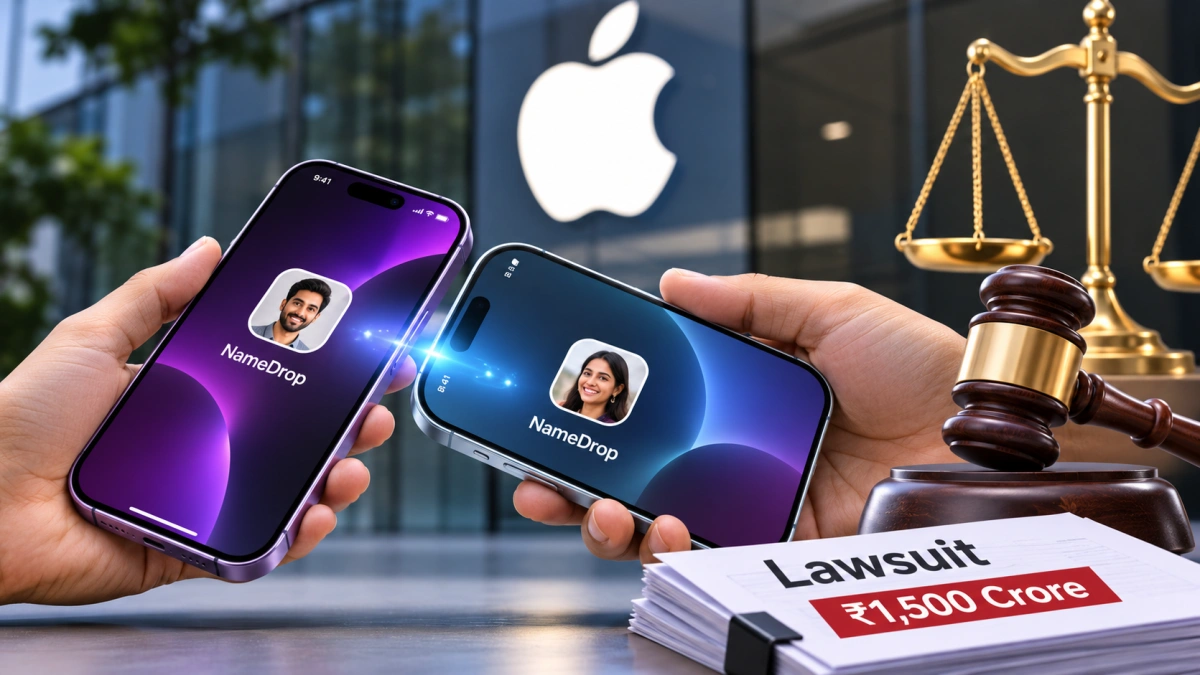
A Convenience Feature Turns Into a Massive Legal Headache for Cupertino
If you own an iPhone or Apple Watch running modern iOS, chances are you have used NameDrop at least once. Introduced by Apple with major fanfare, the feature turns an awkward social ritual into a sleek piece of hardware magic: hold the top edge of two iPhones near each other, watch a glowing ripple animation sweep across both displays, and exchange phone numbers, email addresses, and contact posters instantly without typing a single digit.
Now, that simple tap-to-share interaction sits at the center of one of India’s largest technology intellectual property battles. In a sweeping 781-page lawsuit filed before the Bombay High Court, US-based startup GG Technologies—founded by IIT Delhi alumnus Gaurav Goel—has accused Apple of infringing its patented proximity contact-transfer technology, demanding a staggering ₹1,500 crore (roughly $162 million) in damages alongside a potential court injunction targeting iPhones and Apple Watches sold across India.
As Apple ramps up iPhone manufacturing and retail expansion across Mumbai, Delhi, and Bengaluru, this legal showdown raises high-stakes questions about patent rights, startup-versus-Big-Tech leverage, and whether Indian buyers actually face any risk of losing NameDrop—or seeing iPhone shipments disrupted.
Who Is Suing Apple, and What Is StayTouch?
Unlike faceless “patent trolls” that buy dusty patents solely to extort licensing checks without ever shipping software, GG Technologies built an actual commercial consumer app around this concept years before Apple’s iOS rollout. The company developed StayTouch, a proximity-based digital networking and contact-sharing platform designed to replace physical paper business cards and manual contact swaps.
Gaurav Goel, an alumnus of the Indian Institute of Technology (IIT) Delhi, led the company’s core technical development and secured formal intellectual property protections across major markets—including an Indian patent titled “Method and System for Proximity-Based Contact Transfer,” which was officially granted in July 2024.
Crucially, this Bombay High Court filing did not materialize out of nowhere overnight. GG Technologies and Apple have already locked horns in related patent litigation across the United States. In India, the startup followed mandatory commercial court procedures, engaging Apple in formal pre-institution mediation from April through September 2026. Only after five months of mediation talks collapsed without a licensing settlement did GG Technologies escalate with its exhaustive 781-page plaint in Mumbai in October.
Inside the Patent Claims: Why NameDrop Is Under Fire
To outsiders, holding two phones together to swap contact cards might sound like obvious tech—remember old NFC tags or Samsung’s S Beam from over a decade ago? However, patent disputes turn on highly specific technical claims regarding architecture, user consent flows, and proximity handshake mechanics rather than vague high-level ideas.
According to court filings summarized in Indian tech media reports, GG Technologies alleges that Apple’s NameDrop directly mirrors the protected workflow laid out in its July 2024 Indian patent:
- Proximity Detection Handshake: Using short-range wireless triggers (combining Ultra Wideband, Bluetooth Low Energy, and NFC cues) when two user devices enter a tight physical threshold.
- Bidirectional Contact Card Prompting: Simultaneously waking both screens with synchronized visual confirmation interfaces that let users preview and selectively authorize which contact fields—or “Receive Only” mode—get exchanged.
- Cross-Device Ecosystem Transfer: Extending the exact proximity architecture not just between smartphones, but directly onto wrist-worn smartwatches (like the Apple Watch) interacting with phones.
GG Technologies contends that Apple not only copied the underlying method behind StayTouch without licensing authorization, but crushed the smaller startup’s market viability by baking the patented interaction natively into hundreds of millions of iOS devices for free.
The ₹1,500-Crore Demand and the Threat of an Import Injunction
While the headline ₹1,500-crore damage claim grabs immediate attention, the far sharper weapon sitting in GG Technologies’ legal filing is its request for an injunction blocking the import, sale, and distribution of iPhones and Apple Watches preloaded with NameDrop in India.
Case Detail
Key Facts of the Bombay High Court Filing
Plaintiff
GG Technologies (Creator of StayTouch, founded by IIT Delhi alumnus Gaurav Goel)
Defendant
Apple Inc. / Apple India
Patent at Issue
Indian Patent: “Method and System for Proximity-Based Contact Transfer” (Granted July 2024)
Damages Sought
₹1,500 crore (~$162 million USD)
Equitable Relief Requested
Injunction barring import, distribution, and sale of NameDrop-enabled iPhones & Apple Watches
Timeline
Pre-suit mediation failed (Apr–Sep 2026); 781-page lawsuit filed October 2026
Could iPhones Actually Get Banned From Indian Shelves?
Realistically, an immediate nationwide ban wiping iPhones off Flipkart, Amazon India, and Apple’s flagship stores in BKC and Saket remains an extreme long shot in the near term. Indian High Courts are cautious about granting sweeping preliminary import injunctions on mass consumer electronics—especially when the plaintiff could ultimately be compensated through financial royalties or when invalidation challenges are still untested at trial.
Remember Apple’s recent high-profile wearable patent battles with Masimo in the United States: even when Apple lost a hard medical-sensor patent ruling before the US International Trade Commission, Apple sidestepped a full retail shutdown simply by pushing a targeted software update that disabled blood-oxygen monitoring on newly sold watches while litigation dragged on.
In the worst-case scenario for Apple if GG Technologies scores a major interim legal win in Mumbai, Apple retains two quick escape valves: settle for an undisclosed licensing payout, or ship an India-specific iOS software toggle disabling NameDrop out of the box—just as companies routinely adapt software features to satisfy local court orders.
How Apple Typically Defends Against Feature Patent Suits
Apple’s litigation playbook in high-stakes intellectual property battles is famously thorough. Rather than rushing into early settlements that could encourage dozens of copycat lawsuits globally, Apple’s patent counsel typically attacks on two fronts simultaneously. First, engineers and prior-art researchers scour decades of academic papers, legacy Bluetooth protocols, Android Beam documentation, and early Bump app releases from the 2009–2012 era to argue that proximity-based contact swapping lacked novelty long before StayTouch filed its claims. Second, Apple challenges the technical implementation boundary—arguing that iOS NameDrop’s specific hardware-level UWB/NFC handshake and opt-in Contact Poster architecture operate differently from the exact method steps protected in GG Technologies’ July 2024 patent grant.
Why This Matters for India’s Maturing Patent Landscape
Beyond whether you keep tapping your iPhone to trade numbers at conferences, this dispute highlights two major shifts reshaping technology law in India:
- India Is Now a Primary IP Battleground: Historically, global startups sued Big Tech giants almost exclusively in the Eastern District of Texas, Delaware, or European patent courts because Indian smartphone revenues were too small to force settlement leverage. With India now standing as one of Apple’s fastest-growing revenue engines and a core global assembly hub, winning a commercial injunction threat in the Bombay or Delhi High Court carries real boardroom weight in Cupertino.
- Domestic Talent Fighting Back Globally: Seeing an IIT Delhi alumnus mount a coordinated dual-front patent challenge against the world’s most valuable consumer brand across both US federal dockets and Indian High Courts signals growing confidence among Indian-origin founders to aggressively defend deep IP moats.
For now, NameDrop continues working normally on existing iPhones and Apple Watches across India. Still, as hearings kick off before the Bombay High Court, Apple’s legal team faces an intense technical fight to prove NameDrop’s engineering either predates GG Technologies’ claims or operates outside its patent perimeter. Whether the dispute ends in a confidential cross-licensing pact, a prolonged appellate fight, or a regional software tweak, one reality is clear: India’s courts now carry the commercial clout to put global smartphone features on trial.
Frequently Asked Questions (FAQ)
Why is Apple being sued over NameDrop in India?
US-based startup GG Technologies, creator of the StayTouch app, filed a 781-page lawsuit in the Bombay High Court claiming Apple’s iOS NameDrop violates its Indian patent for “Method and System for Proximity-Based Contact Transfer,” granted in July 2024.
Who owns GG Technologies and StayTouch?
GG Technologies was founded by IIT Delhi alumnus Gaurav Goel, who developed the StayTouch proximity contact-sharing platform and secured patents covering tap-to-transfer contact mechanics in both the US and India.
How much money is GG Technologies demanding from Apple?
The startup is seeking ₹1,500 crore (approximately $162 million) in damages for alleged unauthorized use of its patented contact-transfer technology.
Will iPhones stop selling in India because of this lawsuit?
An outright retail ban is unlikely right away. Even if GG Technologies eventually wins an injunction, Apple could either negotiate a financial licensing settlement or release a software update disabling NameDrop on Indian units to keep iPhones and Apple Watches on store shelves.
Does NameDrop still work on my iPhone in India right now?
Yes. No court injunction has been issued yet, so NameDrop continues operating normally on all compatible iPhones and Apple Watches across India while the Bombay High Court reviews the case.








Comments (0)
No posts yet
Be the first to comment!