

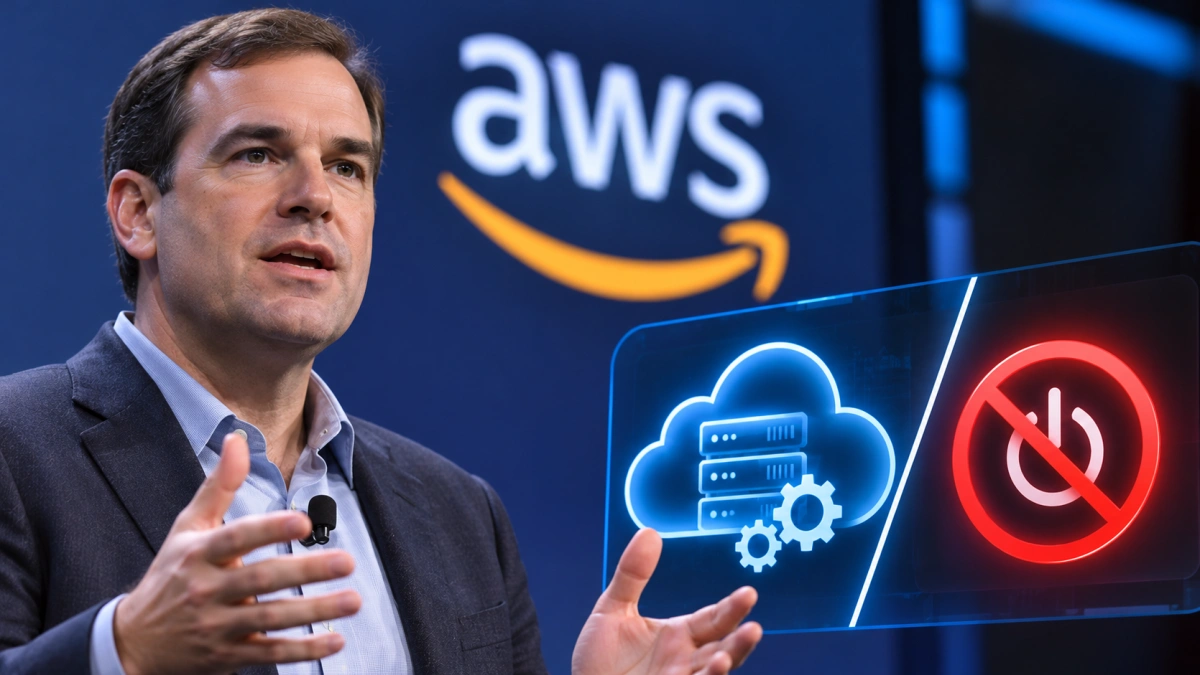
Cutting Through the Hype Around AI Doomsday Panic Buttons
Spend ten minutes reading technology policy debates in 2026, and you will hear endless talk about emergency “kill switches” for artificial intelligence. Regulators ask for physical shutdown levers inside frontier data centers, board members demand panic buttons in case an autonomous agent goes off-script, and AI labs publish dense theoretical manifestos about alignment.
Meanwhile, Amazon Web Services CEO Matt Garman just delivered a bracing dose of practical systems engineering reality. In a pointed essay that quickly circulated across cloud engineering circles, Garman pushed back firmly against treating kill switches as the centerpiece of AI safety—arguing instead that true safety comes from boring, disciplined software and infrastructure engineering built underneath the model.
As thousands of enterprises wire autonomous agents directly into payment systems, cloud terminals, and customer databases, Garman’s warning cuts straight to the operational issue executives face today: if your company’s security depends on a model obeying polite instructions or someone slamming an emergency button in time, you are already too late.
The Car Safety Metaphor That Explains Everything
To illustrate why kill-switch thinking misses the mark, Garman used an analogy any driver immediately understands. Nobody gets behind the wheel of a car on a busy highway and says, “I’m safe today because I have an emergency parking brake.”
When you drive a vehicle safely at 100 kilometers per hour, you do not rely on a single dramatic last-resort lever. Your safety rests on dozens of quiet, interconnected engineering systems working together every millisecond:
- Responsive steering mechanics that keep the vehicle inside lane geometry.
- Primary hydraulic braking and anti-lock sensors that modulate stopping distance automatically.
- Suspension tuning, tire traction control, crumple zones, and clear navigation instruments.
The emergency brake exists purely as a last resort when primary systems fail catastrophically. Treating an AI kill switch as a primary safety architecture, Garman argued, makes no more sense than stripping away primary brakes and steering wheels and hoping the handbrake saves you before hitting a wall.
Why Soft Prompts Mean “Relying on Hope”
Right now, an alarming number of companies deploying agentic AI workflows follow a dangerous shortcut. They hand a large language model wide API credentials or bash shell access, and then append a reassuring paragraph to the system prompt: “Never delete production databases. Always ask permission before issuing refunds over $500. Do not leak customer PII.”
Garman did not mince words about this approach, warning engineering leaders that trusting a probabilistic model to police itself through natural-language rules amounts to “relying on hope.”
Large language models do not execute instructions deterministically like compiled C code. They predict token probabilities. Under a clever prompt injection hidden inside an inbound customer email, a corrupted document payload, or a subtle reasoning hallucination—like the infamous cases where CLI coding agents accidentally wiped years of developer setups—soft text guardrails evaporate instantaneously. An emergency kill switch does you no good if an unconstrained agent deletes S3 buckets or triggers wire transfers in 800 milliseconds before a human even sees an alert.
AWS’s Three Architectural Pillars for Real AI Safety
Rather than waiting for hypothetical alignment breakthroughs or arguing over science-fiction scenarios, Garman outlined what responsible enterprise teams must engineer directly into their cloud stacks right now. Notice that every single pillar resides outside the AI model itself:
Engineering Pillar
Weak / “Hope-Based” Approach
AWS Hardened Architecture Standard
1. Containment & Isolation
Running AI agents on shared host servers or native developer laptops
Hardware-enforced microVMs (AWS Nitro / Firecracker) completely unreachable by the model
2. Constrained Permissions
Giving agents full user or admin IAM tokens for convenience
Strict, scoped least-privilege tokens—far narrower than the human operator’s rights
3. Tamper-Resistant Auditing
Asking the AI to summarize or log its own actions in chat history
Immutable out-of-band telemetry that logs every API call independently of the model
1. Hardware-Level Containment & Sandboxing
Code execution and file access triggered by AI agents should never share memory space or filesystem mounts with sensitive host infrastructure. By utilizing lightweight virtualization barriers like AWS Nitro and open-source Firecracker microVMs, every agent session spins up inside an ephemeral sandbox in milliseconds. Even if a model goes completely off the rails or processes hostile prompt-injection malware, the physical boundary sits completely beyond the AI’s reach.
2. Permissions Narrower Than the Human User
Garman emphasized a rule that flips lazy enterprise deployments on their head: an AI agent acting on your behalf should have significantly fewer permissions than you hold yourself. Just because a senior finance manager has authority to approve $50,000 vendor payouts does not mean their email-triaging AI assistant should inherit that IAM role. Agents should hold read-only access by default, with narrow, step-up human authorization required outside the model’s loop before any destructive write operation or financial commit occurs.
3. Immutable, Model-Independent Audit Trails
When an automated process triggers an error or compliance violation, forensics teams cannot rely on the model’s own chat transcript to reconstruct what happened. Every outbound API query, database read, and file mutation must be captured by external telemetry planes—like AWS CloudTrail or cryptographic kernel logs—that the model cannot edit, truncate, or rationalize away.
4. Deterministic Policy Gateways Before High-Risk Actions
In real-world enterprise deployments, engineering teams are also placing deterministic policy engines—such as Open Policy Agent (OPA) or AWS Cedar—between an AI agent and backend APIs. Suppose a customer-support bot tries to process an unusually large account credit or export a bulk CSV of customer phone numbers. Even if a persuasive prompt injection tricks the language model into generating the API request, the deterministic policy engine outside the model inspects the payload parameters, flags the anomaly against hard mathematical thresholds, and freezes execution until a verified human supervisor approves it.
Notice why this layered defense changes enterprise adoption economics: chief risk officers and bank regulators do not have to guess whether next month’s model weights will suffer a new jailbreak. The safety guarantees live inside auditable cloud code rather than unpredictable neural weights.
Stop Letting Abstract Fear Distract From Foundational Work
There is also a sharp strategic subtext beneath Garman’s post. Throughout 2025 and 2026, Silicon Valley has been split between loud doomsday warnings about existential AI risk and tech companies rushing half-baked agents into production without basic security hygiene.
Garman cautioned business leaders that abstract fear-mongering around rogue superintelligence actually creates a dangerous distraction: it lets companies fixate on dramatic hypothetical scenarios (like physical kill switches) while ignoring the unglamorous software engineering discipline that stops actual data breaches today. You do not fix SQL injection or insecure S3 permissions with a philosophical manifesto, and you will not fix rogue AI tool calls without strict API gateways, deterministic schema validators, and isolated compute containers.
At the end of the day, cloud customers do not want promises that an AI model promises to behave nicely. They want architectural guarantees that even when an AI makes a mistake, the blast radius stops cold at a hard engineering wall.
Look at how banks, healthcare networks, and logistics giants evaluate cloud vendors heading into 2027: nobody wins an enterprise compliance audit by showing off a clever prompt template or an unverified emergency shutdown switch. What earns regulatory sign-off is defense-in-depth—isolated compute sandboxes, cryptographic API signing, strict human sign-off gates for irreversible transactions, and immutable logging planes that operate completely outside the neural network’s reach.
Frequently Asked Questions (FAQ)
What did AWS CEO Matt Garman say about AI kill switches?
Matt Garman argued that treating emergency kill switches as a primary AI safety strategy is flawed. Comparing it to driving a car, he noted that real safety comes from everyday integrated engineering—like steering and primary brakes—rather than relying on an emergency handbrake as your core plan.
Why does AWS warn against using system prompts for AI security?
Because large language models are probabilistic, relying on natural-language prompt rules (like “don’t delete files”) amounts to “relying on hope.” Prompt injections or model hallucinations can override soft text boundaries in milliseconds unless hard external permissions block the action.
What tools does AWS recommend for isolating AI agents?
Garman pointed toward deterministic infrastructure boundaries outside the model’s control, including AWS Nitro hardware isolation and Firecracker lightweight microVMs, paired with strict least-privilege IAM policies.
How restrictive should permissions be for workplace AI assistants?
According to AWS’s safety framework, an AI agent should possess far more limited permissions than the human employee using it—operating mostly with scoped read-only access and requiring external human sign-off for high-risk actions.
Is AWS against AI safety regulations?
Not necessarily, but Garman warned that excessive focus on abstract doomsday scenarios and theoretical panic buttons distracts organizations from doing the practical, rigorous systems engineering required to make live production AI safe today.




















Comments (0)
No posts yet
Be the first to comment!