

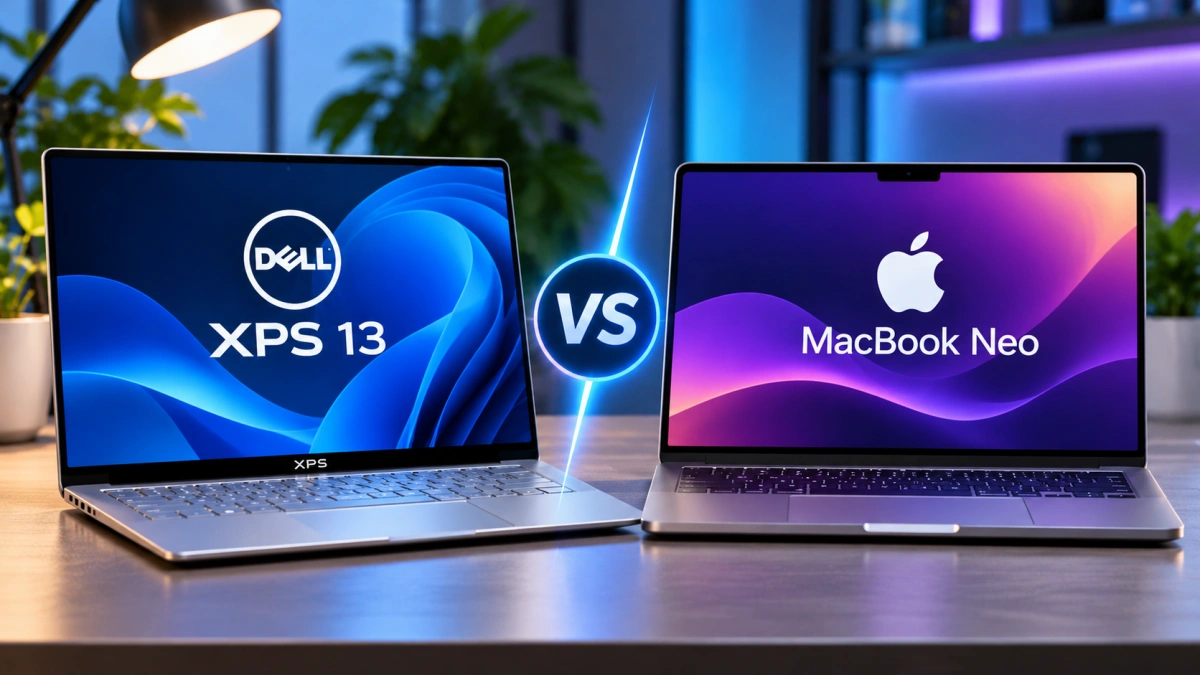
Windows Finally Fires Back at Apple’s Budget Takeover
When Apple unveiled the MacBook Neo earlier this year with an iPhone-derived A18 Pro chip and an aggressive $699 / ₹79,900 starting price, it put traditional PC manufacturers in an uncomfortable spot. For years, Windows laptop makers owned the sub-₹85,000 market simply because Apple refused to play there. Suddenly, students and everyday buyers could walk out with an anodized aluminum MacBook for less than the price of most midrange Windows ultrabooks.
Dell clearly took that threat personally. Rather than inventing a compromised, plastic budget sub-brand to fight Apple at the low end, Dell did something far bolder with the 2026 Dell XPS 13: it took its flagship design crown jewel, trimmed the weight down to a ridiculous 1 kilogram, loaded it with Intel’s Core Series 3 architecture, and lowered the entry barrier all the way down to ₹79,999 in India.
Of course, pushing a luxury flagship line down into mainstream pricing raises immediate red flags. Where did Dell shave corners to hit that ₹79,999 ticket? Does the base 8GB memory tier hold up under Windows 11 in late 2026? And most importantly, if you are choosing between the 2026 Dell XPS 13 and Apple’s MacBook Neo, which laptop actually earns your money? After spending over a week testing both the entry configuration and the high-end Core Ultra 7 variant, here is the unfiltered verdict.
Design & Build Quality: Thinner and Lighter Than the MacBook Neo
Hold the 2026 Dell XPS 13 in one hand and the MacBook Neo in the other, and the engineering contrast hits you immediately. While Apple’s MacBook Neo offers playful finishes like Citrus and Indigo in a sturdy 1.22 kg shell, Dell somehow managed to carve its CNC-machined aluminum unibody down to roughly 1 kilogram (2.2 lbs) and a razor-slim 12.75 mm thickness.
Available in understated Sky and Storm finishes, the XPS 13 feels extraordinarily dense and rigid. There is zero keyboard deck flex when typing aggressively, and the display hinge opens smoothly with a single finger without lifting the base off your desk. Dell also moved away from some of the polarizing touch-bar experiments of earlier years while retaining the minimalist glass palm-rest aesthetic with an invisible haptic touchpad that looks crisp on a coffee shop table.
- Port Selection Reality: Because the chassis is only 12.75 mm thick, Dell strips ports down to the essentials: dual Thunderbolt 4 (USB-C) ports supporting power delivery and DisplayPort video output, plus a modern wireless stack anchored by Wi-Fi 7. There is no USB-A, no HDMI port, and no SD card slot, so keep a compact USB-C dongle in your backpack.
- Thermal Acoustic Tuning: Unlike the completely fanless MacBook Neo, the XPS 13 hides ultra-thin dual micro-fans inside its wedge frame. During web browsing, Google Docs editing, and Spotify playback, the fans stay completely spun down. When pushing heavy batch exports, you hear a soft, non-intrusive whoosh rather than a high-pitched whine.
Display Showdown: 120Hz InfinityEdge Crushes the Neo on Fluidity
If there is one hardware category where the 2026 Dell XPS 13 decisively outperforms the MacBook Neo, it is right in front of your eyes. Apple equips the MacBook Neo with a crisp 13-inch Liquid Retina panel at 500 nits, which is great for static reading—but it remains locked to a standard 60Hz refresh rate.
Dell gives the XPS 13 a 13.4-inch 2.5K (2560 × 1600) InfinityEdge touch display featuring an adaptive variable refresh rate that scales smoothly from 30Hz up to 120Hz. Watching web pages, Excel sheets, and UI animations glide at 120Hz makes the MacBook Neo look noticeably choppy side-by-side.
Beyond smoothness, the panel delivers 500 nits of peak brightness, 100% DCI-P3 color gamut coverage, and impossibly slim bezels on all four sides that make a 13.4-inch screen fit inside a footprint smaller than most 12-inch laptops. Touchscreen responsiveness is also built in—handy for signing PDFs, pinching photos, or scrolling lengthy documents without reaching for the trackpad.
Performance & Specs: Intel Core Series 3 vs. Apple A18 Pro
Dell spans a remarkably wide performance ladder on this generation. You are essentially looking at two very different tiers wrapped inside the same chassis:
Specification
Dell XPS 13 (Entry 2026)
Dell XPS 13 (High-End 2026)
Apple MacBook Neo (2026)
Starting Price (India)
~₹79,999
₹1,80,990 – ₹2,41,990
₹79,900 (US $699)
Processor
Intel Core 5-320 (Series 3)
Up to Intel Core Ultra 7 (Series 3)
Apple A18 Pro (6-core CPU / 5-core GPU)
Display
13.4″ 2.5K Touch (30–120Hz, 500 nits)
13.4″ 2.5K Touch (30–120Hz, 500 nits)
13″ Liquid Retina (60Hz, 500 nits)
RAM Options
8GB LPDDR5X (Soldered)
16GB or 32GB LPDDR5X (Soldered)
8GB Unified Memory
Storage
512GB NVMe SSD
512GB or 1TB NVMe SSD
256GB / 512GB SSD
Weight & Thickness
~1.0 kg | 12.75 mm
~1.0 kg | 12.75 mm
~1.22 kg (2.7 lbs)
Wireless
Wi-Fi 7
Wi-Fi 7
Wi-Fi 6E
Real-World Speed and the 8GB RAM Catch
Let us address the elephant in the room directly: soldered 8GB RAM on an entry-level ₹79,999 laptop in late 2026 is tight. On the base Intel Core 5-320 model with 8GB of LPDDR5X memory, Windows 11 routinely consumes 4.5GB to 5.2GB just sitting idle with Microsoft Defender, background OneDrive syncing, and Copilot services loaded.
During light workloads—say, twelve Chrome tabs, Slack, and Word open—the machine feels fast and snappy. Push past 25 browser tabs while running a Zoom call with background blur and Photoshop open, and Windows starts swapping aggressively to the SSD. Apple’s unified memory management on macOS handles 8GB more gracefully under light pressure, though neither base model is built for heavy 4K timeline editing or multi-container Docker stacks.
If your budget stretches up to the 16GB or 32GB Core Ultra 7 configurations (which jump steeply to ₹1,80,990 and ₹2,41,990 respectively in India), the performance ceiling transforms. Multi-threaded compilation, Lightroom batch exports, and local AI assistant workloads fly effortlessly—though at that price bracket, you are no longer shopping against the MacBook Neo; you are competing with the MacBook Pro and M5 MacBook Air.
And do not buy either of these laptops expecting serious AAA gaming. The integrated Intel graphics handle indie titles, older esports games at lowered 1080p settings, and cloud streaming fine, but heavy 3D rendering requires dedicated discrete GPUs.
Battery Life, Audio & Daily Ergonomics
Inside the ultra-slim 12.75 mm frame sits a 52Wh 3-cell battery paired with a surprisingly compact 65W USB-C GaN charger in the box. Dell rates the machine for up to 17 hours of continuous streaming. In our mixed workday loop—combining Slack messaging, 50% display brightness at adaptive 120Hz, Wi-Fi browsing, and a couple of video meetings—the XPS 13 comfortably delivered 11.5 to 13 hours away from an outlet.
That falls a couple of hours short of the MacBook Neo’s exceptional 15-to-16-hour endurance on Apple Silicon, where ARM efficiency still holds a slight edge in sleep-drain and browser power draw. Still, getting a full cross-country flight or a complete 9-to-6 office day plus evening Netflix on a single charge in a 1 kg Windows machine is impressive.
Audio quality also punches well above its weight class. The quad-speaker array tuned with Dolby Atmos projects clean vocal clarity and noticeable stereo separation—much fuller than the tinny downward-firing speakers found on budget Inspiron or IdeaPad alternatives.
Verdict: Dell XPS 13 (2026) vs. Apple MacBook Neo
Dell accomplished something genuinely hard with the 2026 XPS 13: it brought genuine flagship craftsmanship down into a starting price tier where consumers previously had to settle for thick plastic clamshells.
- Buy the Dell XPS 13 (2026) if: You rely on Windows software, want an impossibly featherlight 1 kg aluminum frame, refuse to settle for a 60Hz non-touch screen when you can get a 120Hz 2.5K InfinityEdge panel, and appreciate getting 512GB base storage plus Wi-Fi 7 out of the box. Just try to stretch for a 16GB configuration if you plan to keep the laptop for four or five years.
- Buy the Apple MacBook Neo if: You already own an iPhone, want maximum unplugged endurance approaching 16 hours, prefer silent fanless operation, and want deep Apple Intelligence continuity without paying flagship MacBook Air prices.
Frequently Asked Questions (FAQ)
What is the starting price of the Dell XPS 13 (2026) in India?
The entry-level 2026 Dell XPS 13 featuring an Intel Core 5-320 processor, 8GB LPDDR5X RAM, and 512GB SSD starts around ₹79,999 in India, directly matching Apple’s MacBook Neo pricing. Higher-end Intel Core Ultra 7 models with 16GB or 32GB RAM range between ₹1,80,990 and ₹2,41,990.
Can I upgrade the RAM on the 2026 Dell XPS 13 after purchase?
No. Like the MacBook Neo and most ultra-thin laptops today, the LPDDR5X memory on the Dell XPS 13 is soldered directly onto the motherboard to maintain the 12.75 mm profile. Choose 16GB at checkout if your budget permits and you run heavy browser workloads.
Does the Dell XPS 13 have better battery life than the MacBook Neo?
Not quite. While the Dell XPS 13 delivers a solid 11.5 to 13 hours of real-world mixed work (and up to 17 hours of light video playback) from its 52Wh battery, Apple’s A18 Pro architecture gives the MacBook Neo roughly 2 to 3 extra hours of unplugged runtime.
Is the Dell XPS 13 good for gaming or heavy 4K video editing?
No. Both the base XPS 13 and the MacBook Neo are designed for portability, productivity, students, and everyday media consumption. Their integrated graphics lack the VRAM and thermal headroom needed for modern AAA gaming or multi-stream 4K color grading.
Why does the 2026 XPS 13 display feel smoother than the MacBook Neo?
Dell ships its 13.4-inch 2.5K InfinityEdge screen with a variable 30Hz–120Hz refresh rate and touch support, whereas Apple locks the MacBook Neo display at 60Hz without touch capability.



















Comments (0)
No posts yet
Be the first to comment!