

A Brutal Reality Check for the World’s Biggest Workplace Cloud
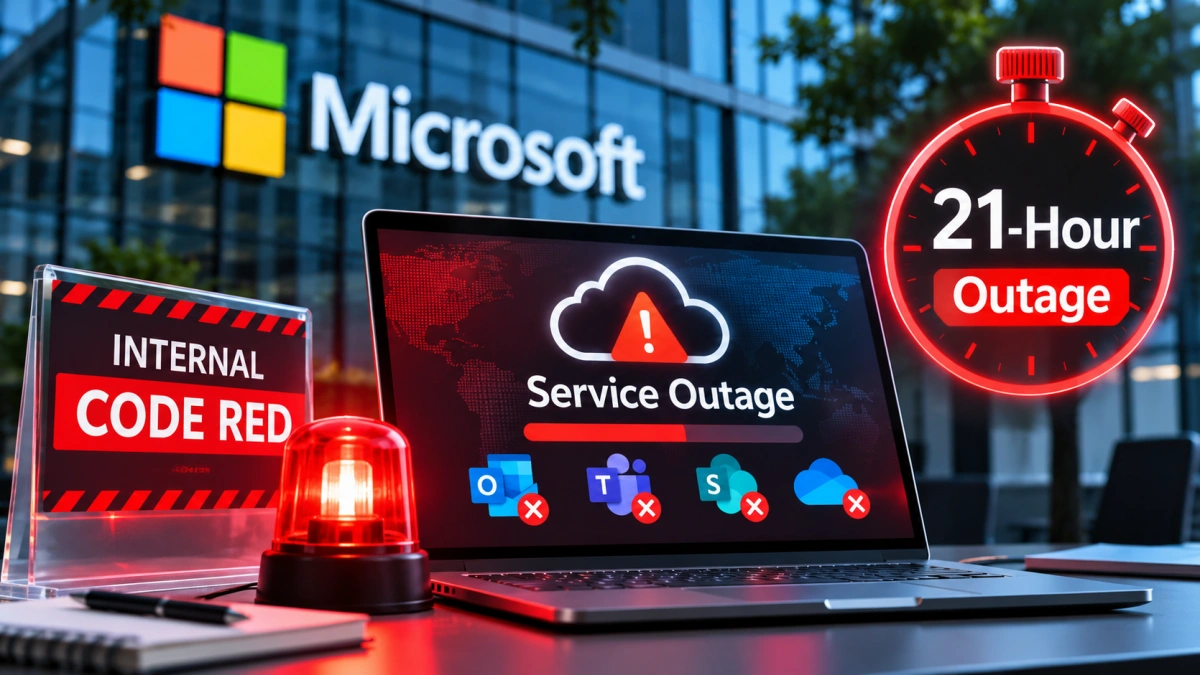
When an entire airline pauses boarding checks, hospital administrators scramble back to paper clipboards, and financial trading desks go quiet because nobody can open an email or join a meeting, you realize just how fragile modern corporate infrastructure really is. Across November 12 and 13, 2026, that worst-case scenario played out on a massive global scale as Microsoft 365 went dark for roughly 21 to 24 hours.
By the time engineers finally stabilized the servers, internal company memos described the event in blunt terms as the single most customer-impacting incident in the history of Exchange Online. Now, Microsoft has pulled the highest emergency lever inside its corporate playbook, declaring an internal “Code Red” across its core cloud and productivity divisions.
For enterprise IT directors, small business owners, and everyday workers wondering how a routine software defect paralyzed global commerce for almost a full day—and whether a cyberattack or rogue AI code was to blame—here is everything inside Microsoft’s crisis response and engineering overhaul.
What Actually Happened During the 21-Hour Blackout?
The outage was not a brief fifteen-minute hiccup confined to a single regional data center. Beginning on November 12, failures cascaded across Microsoft’s global service fabric, knocking out the foundational communication stack that millions of organizations depend on every minute:
- Exchange Online & Outlook: Corporate inboxes stopped sending and receiving messages worldwide, stranding time-sensitive legal contracts, financial invoices, and login verification codes.
- Microsoft Teams: Video conferencing, enterprise voice routing, and real-time internal chat ground to a halt, leaving remote teams unable to coordinate their own internal incident response.
- Copilot AI Integrations: Enterprise Copilot assistants tied into Microsoft Graph failed to fetch documents or respond to prompts, illustrating how tightly AI layers now share single points of failure with core productivity databases.
Governments, healthcare networks, banking institutions, and multinational logistics firms across North America, Europe, and Asia reported prolonged operational paralysis. Unlike minor edge-network glitches where refreshing a browser tab restores access, this outage dragged past the 20-hour mark because engineers could not simply roll back a bad update and walk away.
The Surprising Root Cause: Neither Hackers Nor Rogue AI
Given the geopolitical tension surrounding physical cloud infrastructure and headlines about autonomous AI agents accidentally wiping production configs, initial speculation exploded online. Was Microsoft hit by a nation-state cyberattack? Did an AI coding assistant push broken code straight to Exchange Online?
According to Microsoft’s post-incident engineering findings, the answer to both questions is no. The company explicitly ruled out cyberattacks and AI-authored defects. Instead, the culprit was far more mundane—and arguably far more unsettling for enterprise architects: an undetected Windows scalability defect quietly introduced four months earlier in July 2026.
That dormant bug lingered beneath production traffic for months without triggering alarms. When routine seasonal traffic loads and internal telemetry alignment crossed a hidden threshold in mid-November, the scalability flaw snapped under pressure, sparking cascading retries and lockups across core routing pools.
11,000 Messages and 11 Teams Chats: Inside the Crisis Chaos
Perhaps the most candid detail to emerge from Microsoft’s internal post-mortem was not technical at all—it was organizational. During the height of the 21-hour meltdown, Microsoft’s own engineering response teams were drowning in fragmented communication.
Internal disclosures revealed that responders exchanged more than 11,000 messages scattered across 11 separate Microsoft Teams chat channels while frantically trying to pinpoint the failure and coordinate restarts. Think about the irony and danger of that bottleneck: engineers trying to rescue Microsoft Teams and Exchange Online were slowed down by noisy, siloed chat threads where critical diagnostic telemetry got buried under thousands of overlapping status pings.
When a hyperscaler’s blast radius spans multiple continents, losing precious hours to uncoordinated war rooms turns a two-hour recovery into a day-long global headline.
What Microsoft’s “Code Red” Actually Means
In Redmond, “Code Red” is not an empty PR slogan. Historically reserved for existential security threats—like Bill Gates’ famous 2002 Trustworthy Computing memo or the emergency security overhaul following 2023–2024 state-sponsored breaches—declaring a Code Red immediately freezes non-essential feature sprints and redirects top engineering talent directly onto foundational reliability.
Spearheaded by senior leadership including Microsoft 365 Core President Jason Henderson, the Code Red mandate forces four structural changes across how Microsoft builds and operates its productivity cloud:
Code Red Pillar
Previous Vulnerability Exposed in Nov 2026
New Engineering Standard
Recovery Speed Target
21+ hours to stabilize global traffic
Strict 1-hour maximum global resolution target
Fault Isolation
Latent Windows scalability defect rippled worldwide
Harder traffic isolation and strict regional blast-radius rings
Load Management
Retry storms overwhelmed recovery pipelines
Automated load-shedding and throttled failover pools
Incident Diagnostics
11,000+ noisy messages across 11 fragmented chats
Unified war rooms assisted by diagnostic AI health agents
1. The Ambitious One-Hour Global Recovery Goal
The headline target inside the Code Red directive is unmistakable: resolve future worldwide service disruptions within 60 minutes. Reaching a one-hour recovery ceiling requires moving away from slow human detective work during active meltdowns and automating rapid “known-good” failover states before cascading failure corrupts downstream caches.
2. Regional Blast-Radius Isolation
In a properly compartmentalized cloud, a scalability bug triggered in one geography should trip a circuit breaker locally rather than poisoning global routing tables. Microsoft is restructuring deployment rings and cross-region dependencies so core email and messaging clusters run with tighter regional air gaps.
3. Deploying AI Agents for Triage—Not Code Replacement
Ironically, while Microsoft had to assure customers that AI did not break Exchange Online, part of its Code Red rescue plan involves leaning harder on specialized internal AI diagnostic agents. Rather than expecting exhausted engineers to sift through terabytes of logs across 11 chaotic chat rooms, automated diagnostic assistants will correlate anomaly spikes, match telemetry against recent kernel or Windows build regressions, and present root-cause candidates within minutes.
4. Rebuilding Deployment Validation Gates
Perhaps the toughest question customers asked after November 13 was straightforward: how did a defect introduced in July survive four months of automated staging tests before detonating in November? Under the Code Red blueprint, Microsoft is introducing stricter synthetic load-testing gates that replay peak seasonal concurrency spikes—including simulated Monday-morning authentication surges and mass calendar sync storms—before any Windows server build graduates to broad Exchange Online rings.
The Business Cost of Single-Vendor Cloud Concentration
Beyond Redmond’s internal engineering overhaul, the 21-hour blackout forced an uncomfortable boardroom conversation worldwide. Over the past decade, enterprises migrated away from on-premise Microsoft Exchange servers precisely because running local mail hardware felt risky and expensive. Handing email, chat, identity management, and AI productivity over to one hyperscaler promised 99.99% uptime backed by multibillion-dollar data centers.
Yet when Microsoft 365 experiences a global control-plane failure, thousands of competing companies across banking, aviation, and healthcare stop operating simultaneously. Regulators in Europe and North America have already signaled tighter operational resilience scrutiny—meaning enterprise CIOs can no longer treat cloud migration as a complete outsourcing of uptime risk.
What Businesses and IT Teams Should Do Right Now
Microsoft’s Code Red is welcome news for long-term cloud stability, but waiting on a vendor’s internal overhaul is never a substitute for your own disaster recovery plan. Every CIO and business owner using Microsoft 365 should take three immediate precautions:
- Build an Out-of-Band Crisis Channel: Never let your company’s emergency communications rely exclusively on the same vendor whose productivity suite just went down. Keep an independent Slack workspace, Signal group, or SMS alert tree ready if Microsoft Teams and Outlook fail simultaneously.
- Maintain Offline Access to Critical Playbooks: Ensure emergency vendor phone numbers, DNS credentials, and security incident runbooks live outside SharePoint and OneDrive so your team isn’t locked out of recovery docs during an authentication outage.
- Audit Third-Party Email Continuity: For financial and healthcare firms where 21 hours without email creates legal liability, evaluate secondary SMTP continuity relays that queue and deliver urgent mail independently during Microsoft 365 downtime.
Frequently Asked Questions (FAQ)
Was the 21-hour Microsoft outage caused by hackers or a ransomware attack?
No. Microsoft’s internal investigation confirmed the outage was not caused by a cyberattack, external intrusion, or AI-generated code. It stemmed from an undetected Windows scalability defect introduced months earlier in July 2026.
Which Microsoft services stopped working during the incident?
The outage hit core Microsoft 365 cloud pillars globally, including Exchange Online, Outlook email, Microsoft Teams chat and video calls, and enterprise Copilot AI integrations.
Why did it take Microsoft over 21 hours to fix the problem?
Two factors prolonged recovery: the hidden scalability flaw lingered from July and triggered cascading load spikes worldwide, while engineers struggled with fragmented incident coordination across 11 separate Teams channels generating over 11,000 messages.
What does Microsoft’s internal “Code Red” change for customers?
Led by M365 Core President Jason Henderson, Code Red shifts top engineering focus toward blast-radius isolation, reduced system loads, AI-assisted fault telemetry, and a hard operational target to fix any future global disruption within one hour.
Are Microsoft 365 prices changing because of Code Red?
No pricing changes have been announced. Code Red is an internal engineering and operational reliability mandate focused on restoring enterprise trust and meeting strict service-level uptime guarantees.



















Comments (0)
No posts yet
Be the first to comment!