

Closing the Most Dangerous Window in Enterprise Cybersecurity
Ask any senior Linux systems administrator what keeps them awake at night, and they rarely say a lack of security alerts. Most companies already drown in vulnerability scanners screaming about hundreds of newly disclosed CVEs every month. The real nightmare is the patch gap—that tense window of days, weeks, or even months between when a critical zero-day vulnerability hits the public internet and when an engineering team can safely test, validate, and roll out an official kernel or package update without crashing production workloads.
Traditional emergency workarounds during that gap are usually brutal. You either shut down a revenue-generating server completely, disable a broad OS subsystem that breaks dependent apps, or cross your fingers behind a noisy Web Application Firewall rule and hope attackers miss the edge case.
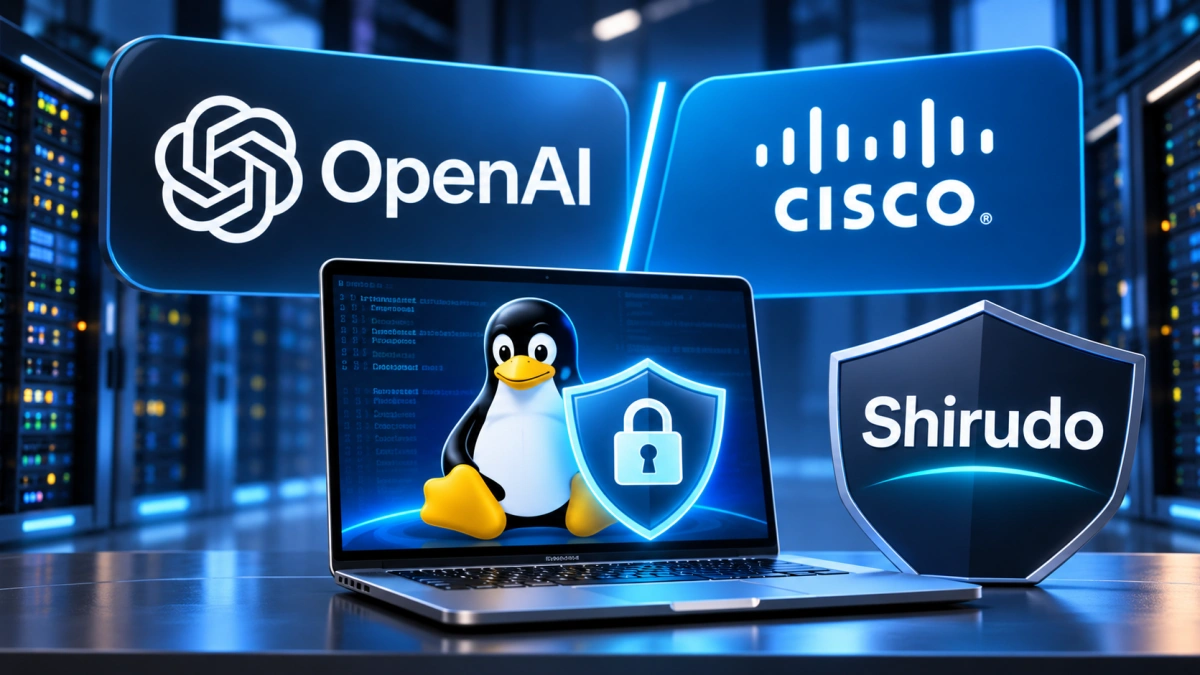
To eliminate that painful trade-off, OpenAI and Cisco just teamed up in November 2026 to release Shirudo—named after the Japanese word for “shield.” Hosted as an open-source project under the shirudo-dev organization on GitHub, Shirudo combines the surgical power of Linux eBPF (Extended Berkeley Packet Filter) with AI-assisted mitigation code and hardware-backed cryptography to neutralize live exploits on running servers without a single restart.
What Is Shirudo and Why Did OpenAI and Cisco Build It?
At its core, Shirudo is a hardened Linux security runtime and mitigation architecture released under permissive open-source licensing (BSD 2-Clause for user-space tooling, dual BSD/GPL for kernel BPF programs). Instead of trying to replace traditional software patching altogether, Shirudo buys engineering teams critical breathing room by deploying pinpoint runtime guards—called “shields”—directly inside a live system.
Consider why Cisco and OpenAI joined forces on this specific problem. Cisco owns massive enterprise networking and workload telemetry visibility through its security stack, while OpenAI has been pushing coding agents like Codex into complex vulnerability analysis and defensive patch drafting. An AI model can read a freshly published CVE advisory, examine the vulnerable C or Java call stack, and write a 40-line mitigation filter in twenty seconds. The missing piece was a safe, locked-down execution layer inside Linux that refuses to blindly trust unverified code while still letting authorized shields block active attacks at kernel speed.
How It Works: Inside eBPF “Shields” and the Java4Shell Demo
Traditional Linux kernel modules are notoriously risky. Load a buggy kernel module into production and you trigger an instant kernel panic that takes the entire host offline. eBPF bypasses that danger by running tiny, sandboxed bytecode programs inside the Linux kernel only after the kernel’s strict verifier proves the code cannot crash, enter infinite loops, or leak arbitrary memory.
Blocking Java4Shell Without Restarting Elasticsearch
To demonstrate Shirudo in real-world conditions rather than abstract slides, OpenAI and Cisco engineers ran a live demonstration targeting a notorious Java4Shell exploit path against an active, running Elasticsearch cluster.
Normally, stopping a remote code execution vulnerability inside a live Java service requires taking nodes out of rotation, patching the library, and waiting for multi-gigabyte JVM heaps to warm back up. With Shirudo running:
- AI-Assisted Shield Drafting: OpenAI’s Codex model analyzed the vulnerable code path and authored a surgical eBPF shield targeting the exact function entry point where malicious payloads triggered deserialization abuse.
- Runtime Injection: Rather than shutting down Java or blocking all HTTP traffic, Shirudo injected a tiny input validation check directly into Java’s Base64 decoder at runtime.
- Zero-Downtime Filtering: When the exploit script fired against the Elasticsearch cluster, the shield intercepted the malformed payload and dropped the attack dead in its tracks—while thousands of legitimate customer search queries kept flowing without a millisecond of service interruption.
Locking Down the Kernel: Cryptography, Syscalls, and TPM Logs
Anyone familiar with offensive Linux security immediately asks an obvious question: If a tool can load eBPF probes that intercept core system and user-space decoders at runtime, what stops a hacker from abusing that exact mechanism to plant a stealthy rootkit?
OpenAI and Cisco anticipated this threat model and built three strict hardware and cryptographic boundaries directly into Shirudo’s architecture:
Security Layer
Threat Addressed
How Shirudo Enforces Safety
Cryptographic Shield Signing
Unauthorized or tampered eBPF code injection
Every shield must carry a valid digital signature before the runtime accepts it
Restricted
Privilege escalation or rogue user-space loaders
Locks down the native Linux bpf() system call so only verified, signed loaders can attach probes
TPM Hardware Audit Trail
Stealth modifications or post-incident log tampering
Logs every shield load and removal event directly into the machine’s Trusted Platform Module (TPM) chip
Human-in-the-Loop Gate
Hallucinated or over-aggressive AI mitigations
AI drafts and tests the shield, but a human security engineer holds the signing keys to push it live
Why TPM Logging Changes Incident Forensics
Storing audit logs only in /var/log is dangerous because any attacker who compromises root privileges can simply wipe the text logs behind them. By anchoring shield lifecycle events directly to the server’s physical Trusted Platform Module (TPM), Shirudo guarantees an immutable hardware-attested timeline. Security teams and compliance auditors can prove cryptographically which shields ran on which hosts, when they loaded, and who signed off on them.
Agentic Security With a Mandatory Human Brake Pedal
There has been plenty of hype—and justified skepticism—around fully autonomous “self-healing” AI cybersecurity tools. As several real-world autonomous CLI mishaps have proven, letting an LLM execute unreviewed changes straight into production is playing Russian roulette with uptime.
Shirudo draws a clean, pragmatic boundary around what AI should own versus what humans must control:
- What the AI Agent Handles: Rapidly parsing CVE threat feeds, identifying vulnerable function symbols on your specific Linux kernel or container images, synthesizing the minimal eBPF verification filter, and running automated regression tests inside an isolated staging sandbox.
- What Human Operators Control: Reviewing the concise eBPF diff, inspecting test telemetry, and applying the physical or hardware-backed cryptographic signature required before Shirudo allows the shield onto live fleet nodes.
This workflow captures the speed advantage of machine-generated defense—shrinking vulnerability exposure from weeks to minutes—while keeping accountability squarely with human security engineers.
How Shirudo Compares to Traditional Runtime Security Tools
Security teams might reasonably wonder how Shirudo differs from Web Application Firewalls (WAFs), Endpoint Detection and Response (EDR) agents, or traditional Linux Security Modules like SELinux and AppArmor. The distinction lies in surgical precision inside live application memory:
- WAFs Operate Too High Up: A perimeter firewall only sees external HTTP traffic. If a vulnerability sits deep inside an internal message queue, an encrypted microservice call, or a specific deserialization library routine, perimeter rules either miss the payload or block valid business traffic.
- Traditional EDR Tools Mostly Alert After the Fact: Most endpoint sensors detect suspicious child processes after an attacker already executes shellcode. Shirudo stops the underlying vulnerable function call before execution ever escapes the sandbox.
- Live Kernel & User-Space Telemetry Combined: Using eBPF uprobe and kprobe hooks, Shirudo inspects arguments right at function boundaries with minimal CPU overhead, letting high-throughput Elasticsearch or Kubernetes clusters keep operating at full speed.
What Shirudo Means for Cloud and DevOps Teams
For infrastructure teams running massive Kubernetes fleets, legacy enterprise Java workloads, or high-availability databases that cannot tolerate unplanned mid-day reboots, Shirudo arrives as a genuinely practical open-source tool rather than vendor lock-in vaporware. Because it relies on standard upstream Linux eBPF primitives rather than proprietary kernel forks, teams using modern Red Hat, Ubuntu, Debian, or Amazon Linux distributions can evaluate it directly from the shirudo-dev repository.
Zero-day bugs aren’t slowing down—especially as offensive hackers automate exploit discovery with the same frontier models defenders use. Projects like Shirudo show that runtime defense can finally move at the same speed as exploitation, without forcing DevOps teams to choose between getting hacked and shutting the business down.
Frequently Asked Questions (FAQ)
What does the name “Shirudo” mean?
Shirudo comes from the Japanese word for “shield” (シールド). OpenAI and Cisco chose the name to reflect how the platform places lightweight, targeted defensive shields around vulnerable software functions in real time.
Does Shirudo replace traditional software patching?
No. Shirudo is specifically designed as a temporary runtime bridge to protect live Linux systems during the dangerous “patch gap” while engineers test and deploy permanent upstream vendor patches or kernel updates.
Can Shirudo break legitimate traffic or crash the Linux kernel?
Every shield runs through the standard Linux kernel eBPF verifier, which mathematically blocks unsafe memory access or infinite loops. Additionally, because shields inspect targeted functions rather than killing entire services, legitimate production traffic keeps flowing—as shown in the live Elasticsearch Java4Shell demonstration.
Does OpenAI’s AI automatically push shields to my servers without asking?
No. While AI tools like Codex can draft and verify shields automatically, Shirudo enforces cryptographic signature verification and locks down the bpf() syscall. Human operators hold the signing keys and must approve any shield before it loads in production.
Is Shirudo free to use and open source?
Yes. OpenAI and Cisco released Shirudo as an open-source project under the BSD 2-Clause license (with dual BSD/GPL licensing for kernel BPF components) under the shirudo-dev organization on GitHub.


















Comments (0)
No posts yet
Be the first to comment!